
AI Shopify App Builder: How AI Is Changing Ecommerce Mobile Apps
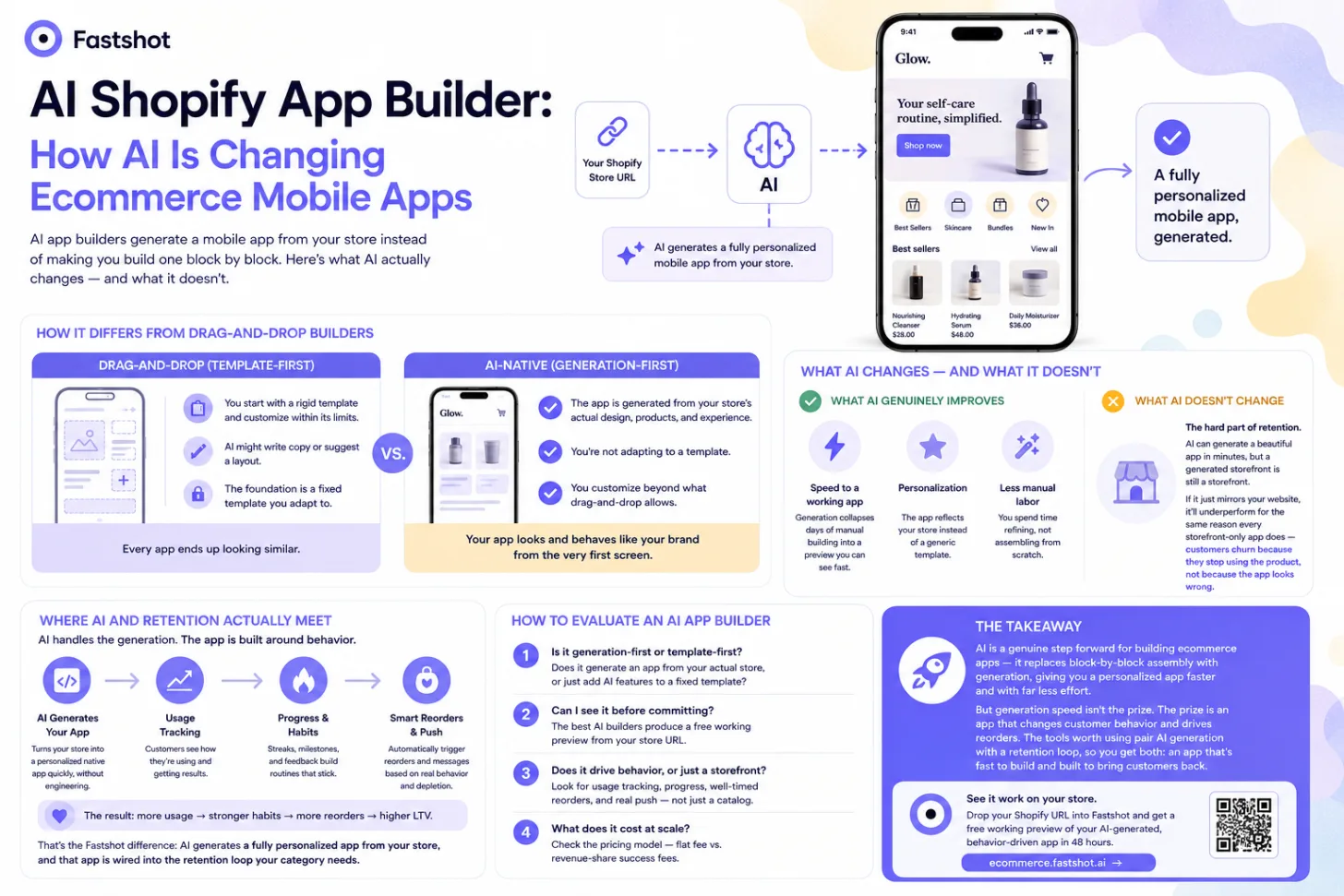
For years, building a Shopify app meant the same thing: open a drag-and-drop editor and assemble your app block by block, screen by screen. AI is changing the starting point. Instead of building an app from an empty canvas, an AI Shopify app builder generates one from your store — your products, your design, your experience — and lets you refine from there. It's a real shift, but the term "AI app builder" is also getting slapped onto everything, so it's worth separating what AI genuinely changes from what's just a label.
What an AI Shopify app builder actually is
At its simplest, an AI app builder turns an input — your store URL, or even a plain description of what you want — into a working mobile app, automatically. Rather than choosing templates and dragging components, you point it at your Shopify store and it produces a personalized app generated from what's already there. The promise is speed and personalization: less manual assembly, an app shaped to your store rather than forced into a generic template.
How it differs from drag-and-drop builders
The distinction matters because most "app builders" are still template tools with AI features bolted on. There's a real difference between AI-assisted and AI-native:
- Drag-and-drop (template-first): you start with a rigid template and customize within its limits. AI might write some copy or suggest a layout, but the foundation is a fixed template you adapt to.
- AI-native (generation-first): the app is generated from your store's actual design, products, and experience. You're not adapting to a template — the starting point is already yours, and you customize beyond what drag-and-drop allows.
The practical payoff of the generation-first approach is that you escape the "every app looks the same" problem. Template builders tend to produce apps that feel interchangeable. A generated app starts from your brand, so it looks and behaves like your store from the first screen.
What AI changes in ecommerce apps — and what it doesn't
It's easy to overstate AI here, so let's be precise.
What AI genuinely improves:
- Speed to a working app — generation collapses days of manual building into a preview you can see fast.
- Personalization — the app reflects your store instead of a generic template.
- Less manual labor — you spend time refining, not assembling from scratch.
What AI doesn't change:
- The hard part of retention. AI can generate a beautiful app in minutes, but a generated storefront is still a storefront. If it just mirrors your website, it'll underperform for the same reason every storefront-only app does — customers churn because they stop using the product, not because the app looks wrong.
This is the trap in a lot of AI app-builder marketing: it sells generation speed as if speed were the goal. Speed is nice. But the app still has to do something — drive usage, build a habit, trigger reorders — or it won't move your numbers no matter how quickly AI produced it.
Where AI and retention actually meet
The most useful way to think about AI in an ecommerce app isn't "how fast can it generate a storefront." It's "can it generate an app built around behavior." The two ideas combine well:
- AI handles the generation — turning your store into a personalized native app quickly, without engineering.
- The app is built around a usage loop — a guided experience, visible progress, and well-timed reorders — so it drives repeat purchases rather than just displaying products.
That combination is the point of Fastshot: AI generates a fully personalized app from your store, and that app is wired into the retention loop your category needs — usage tracking, progress and streaks, reorder triggers tied to real depletion, and behavior-based push notifications. You get the speed and personalization of AI and an app designed to turn one-time buyers into repeat customers.
How to evaluate an AI app builder
When a tool calls itself an "AI Shopify app builder," ask:
- Is it generation-first or template-first? Does it generate an app from your actual store, or just add AI features to a fixed template?
- Can I see it before committing? The best AI builders produce a free working preview from your store URL.
- Does it drive behavior, or just generate a storefront? Look for usage tracking, progress, well-timed reorders, and real push — not just a fast-built catalog.
- What does it cost at scale? Check the pricing model — flat fee vs. revenue-share success fees.
Choosing an AI Shopify app builder
AI is a genuine step forward for building ecommerce apps — it replaces block-by-block assembly with generation, giving you a personalized app faster and with far less effort. But generation speed isn't the prize. The prize is an app that changes customer behavior and drives reorders. The tools worth using pair AI generation with a retention loop, so you get both: an app that's fast to build and built to bring customers back.
See it work on your store: drop your Shopify URL into Fastshot and get a free working preview of your AI-generated, behavior-driven app in 48 hours.
Frequently asked questions
What is an AI Shopify app builder? A tool that generates a mobile app from your Shopify store automatically — using your products, design, and experience — instead of making you build it block by block in a drag-and-drop editor.
Can AI build a mobile app from just my store URL? Yes. Generation-first builders take your store URL and produce a working app preview, which you then refine. Fastshot does this and shows you the preview free, with no card.
Is an AI-built app better than a template app? It can be, because it starts from your brand rather than a generic template — but only if it also drives behavior. A fast-generated storefront still underperforms unless it's built around a usage and reorder loop.
See your app before you commit
Drop your Shopify store URL into Fastshot and get a free working app preview — built around your retention loop — in 48 hours. No card, no engineering.
Get my free preview →