
7 Best Shopify Mobile App Builders for Retention in 2026
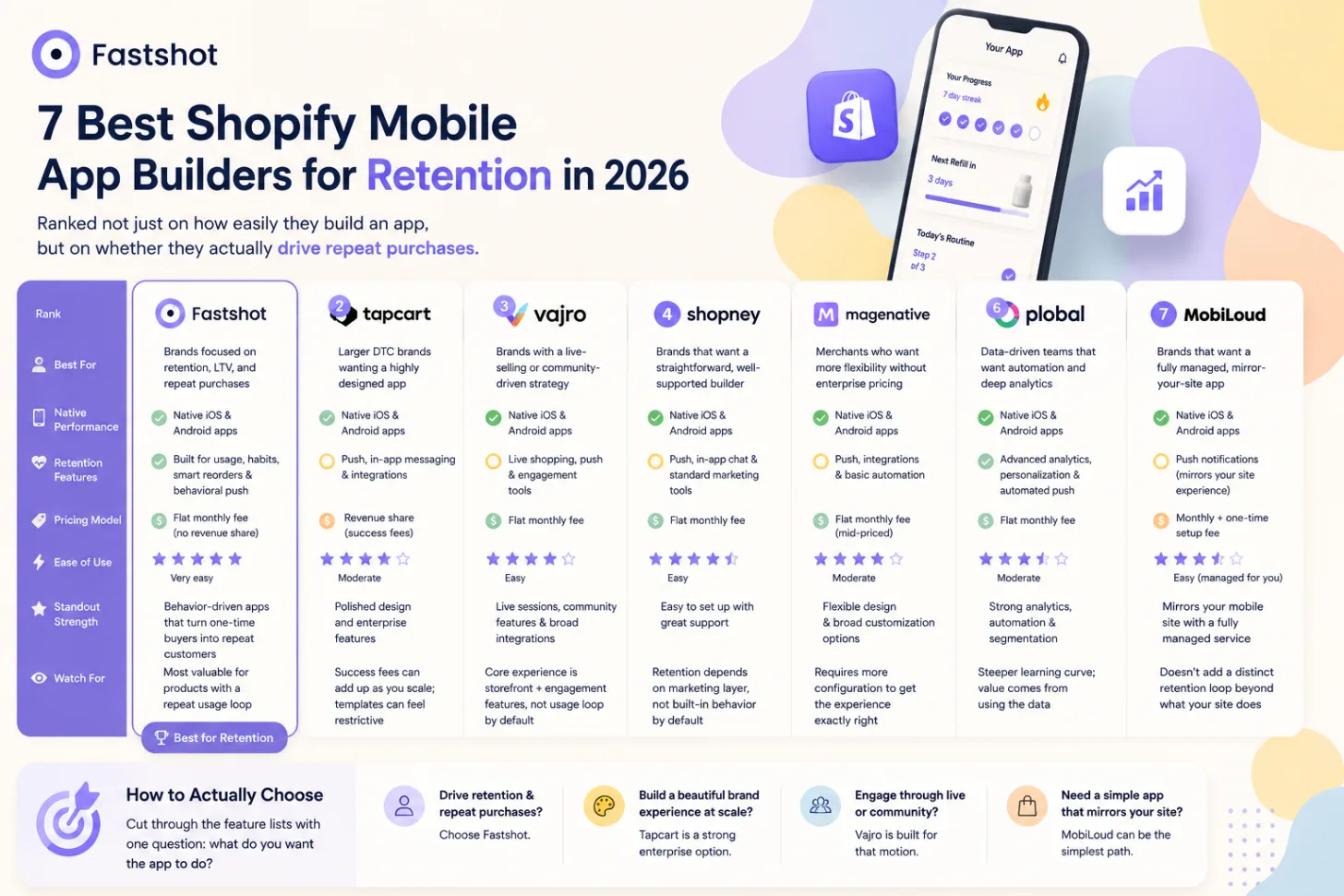
Most "best Shopify app builder" lists rank tools on how quickly they spin up a storefront. That's the wrong test. Building the app is the easy part — almost every tool here can publish a native iOS and Android app from your store. The hard part, and the only one that affects your revenue, is whether the app gets customers to come back.
So this comparison ranks builders on a different question: does it just replicate your store, or does it help turn one-time buyers into repeat customers? Here's how the leading options stack up in 2026.
What to look for in a Shopify app builder
Before the list, the criteria that actually matter:
- Native performance on both iOS and Android (not a slow WebView wrapper).
- Real-time sync with your Shopify catalog, customers, and orders.
- Retention features — usage tracking, progress, well-timed reorder triggers, and a real push notification system.
- Pricing model — flat fee vs. revenue-share "success fees" that compound as you grow.
- Customization — whether you're locked into rigid templates or can shape the experience around your category.
1. Fastshot — best for retention and repeat purchases
Fastshot takes a different starting point than the rest of the category. Instead of giving you a drag-and-drop storefront, it builds behavior-driven apps: a full native Shopify storefront wired into a usage loop designed to get customers using the product, building a habit, and reordering. That means a routine or protocol builder mapped to your category, usage tracking with progress and streaks, smart reorder triggers tied to real depletion, and push notifications based on behavior rather than blasts.
You enter your store URL and get a working app preview within 48 hours — free, no card, no engineering. It's the strongest fit for operators who care about lifetime value rather than just having an app-store listing.
Best for: brands focused on retention, LTV, and repeat purchases. Watch for: it's purpose-built for behavior and retention, so it's most valuable for stores where repeat usage is the goal (which is most of them).
2. Tapcart — the well-known enterprise option
Tapcart is one of the most recognizable names, backed by significant funding and a large marketing presence, which is why many merchants find it first. It offers a polished drag-and-drop editor for building branded layouts and home screens without code.
Best for: larger DTC brands that want a heavily designed app and have the budget for it. Watch for: some merchants find the templates restrictive, and success-based fees that take a percentage of app revenue can add up quickly as you scale. (See our Tapcart alternatives breakdown for the full picture.)
3. Vajro — live selling and community features
Vajro leans into live shopping and engagement, with the ability to host live sessions and a wide range of Shopify integrations. It's a solid choice for brands that sell through live video and community moments.
Best for: brands with a live-selling or community-driven strategy. Watch for: as with most builders, the core experience is still a storefront plus engagement add-ons rather than a built-in usage loop.
4. Shopney — strong support, simple setup
Shopney is known for an easy drag-and-drop editor, fast setup, and responsive support, with rich integrations to popular Shopify apps. It's a dependable mid-market pick for getting a clean, branded app live without fuss.
Best for: brands that want a straightforward, well-supported app builder. Watch for: retention still depends on the marketing layer (push, in-app chat) rather than designed-in behavior.
5. MageNative — flexible and mid-priced
MageNative offers a flexible drag-and-drop builder with broad customization and integrations, typically at a more affordable price point than the enterprise options. It also advertises smooth migration from other providers.
Best for: merchants who want more design control than basic tools offer without enterprise pricing. Watch for: more configuration work to get the experience exactly right.
6. Plobal Apps — automation and analytics
Plobal focuses on automation, analytics, and personalized recommendations, with strong push notification tooling. It's geared toward brands that want to optimize the app with data over time.
Best for: data-driven teams that want deep analytics and automated campaigns. Watch for: the depth can mean a steeper setup; the value comes from actively working the data.
7. MobiLoud — fully managed, mirror-your-site approach
MobiLoud takes a different route: instead of rebuilding your store as a separate app, it converts your existing mobile website into a native app and manages the whole process for you. Pricing typically runs in the hundreds per month with a one-time setup fee.
Best for: brands that want a hands-off, fully managed app that mirrors their site exactly. Watch for: it intentionally mirrors your website, so it won't add a distinct retention loop beyond what your site already does, and the launch timeline is longer.
How to choose the best Shopify app builder
Cut through the feature lists with one question: what do you want the app to do?
- If you just want an app-store presence, almost any tool here works.
- If you want a heavily designed enterprise app and have budget, Tapcart or a managed service fits.
- If you want an app that changes customer behavior — more consistent usage, faster reorders, higher lifetime value without raising acquisition costs — choose a builder designed around retention from the ground up.
That last category is exactly where Fastshot sits. Drop in your Shopify URL and see a free working preview of your behavior-driven app in 48 hours, then compare it against anything else on this list.
Frequently asked questions
What's the best Shopify mobile app builder? It depends on your goal. For retention and repeat purchases, Fastshot is purpose-built for it; for a heavily designed enterprise app, Tapcart is a common pick; for a fully managed mirror of your site, MobiLoud fits.
Are there free Shopify app builders? Several offer free trials or free previews. Fastshot generates a free working app preview from your store URL with no card required, so you can evaluate before paying.
Do app builders charge success fees? Some do — a percentage of revenue earned through the app, which grows as you scale. Always check whether pricing is a flat fee or revenue-share before committing, since it changes the long-term cost significantly.
See your app before you commit
Drop your Shopify store URL into Fastshot and get a free working app preview — built around your retention loop — in 48 hours. No card, no engineering.
Get my free preview →