
Shopify Customer Retention: Why You Lose 70% of Buyers After the First Order
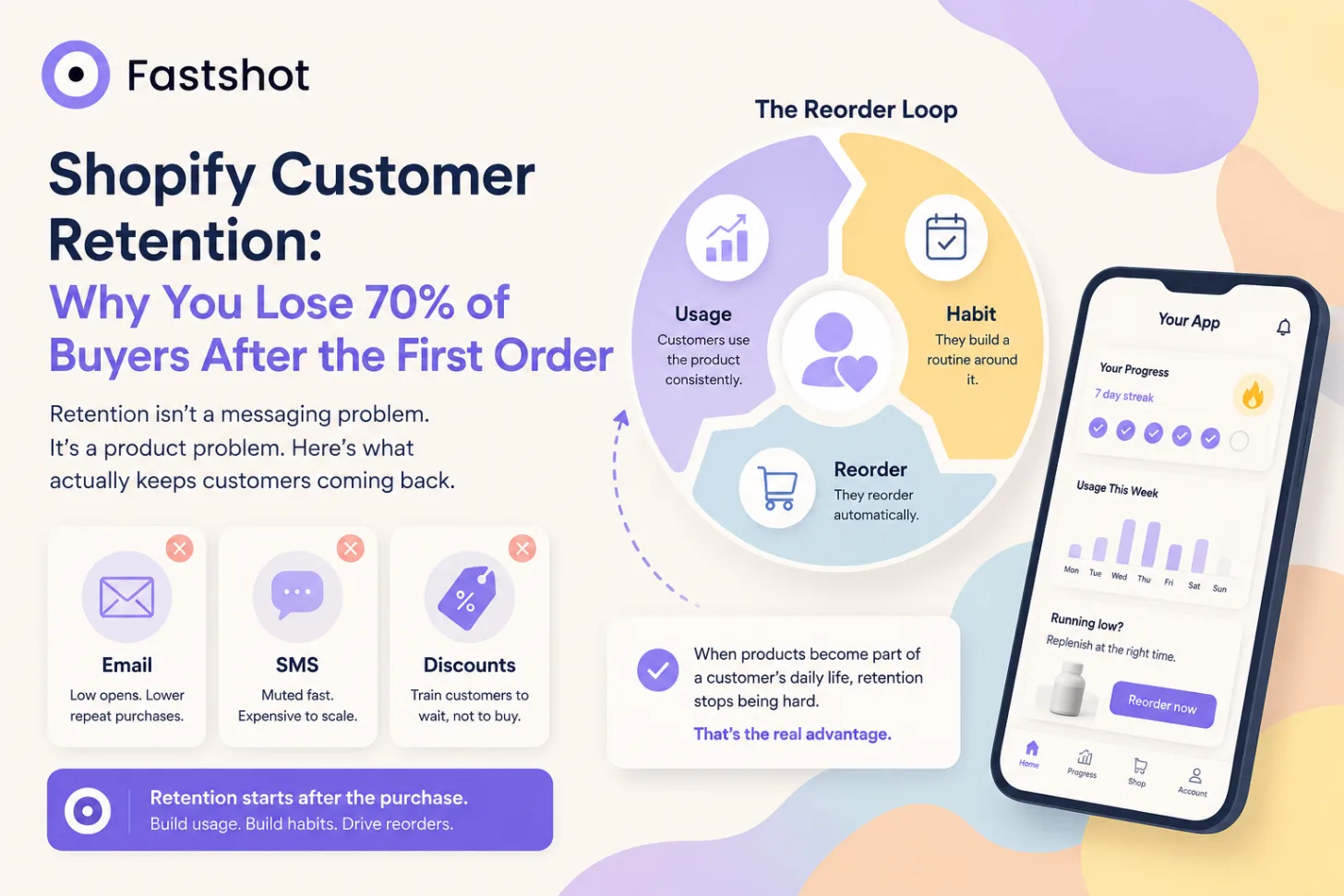
There's a number that quietly decides whether a Shopify brand grows or stalls: how many customers come back. For most stores, the answer is not many. A typical brand loses up to 70% of its customers after the first purchase. They buy once and never return.
That wouldn't matter much if acquiring the next customer were cheap. But it isn't. Ad costs keep climbing, channels are crowded, and first-order profit keeps shrinking. When acquisition gets more expensive and retention stays flat, the math stops working — you're paying more to replace customers you should have kept.
This article is about why that churn happens, why the usual fixes don't move it, and what actually does.
Why email, SMS, and discounts don't fix churn
Faced with churn, most brands reach for the same three tools: more email, more SMS, more discounts. It feels like action. It rarely is.
- Email is a graveyard. Click-through rates hover in the low single digits, which means the overwhelming majority of customers never act on what you send.
- SMS costs money per message, gets muted quickly, and isn't built for the kind of daily engagement that creates a habit.
- Discounts train customers to wait for the next promo rather than to use what they already bought. You're not building loyalty; you're renting purchases and eroding your margin.
The deeper problem is that all three are communication tools, and you're trying to solve a behavior problem with them. A reminder can nudge someone who already wants to come back. It can't manufacture a reason to return that doesn't exist yet.
Why customers churn after the first purchase
Strip away the dashboards and it comes down to one thing: customers stop buying because they stop using the product.
Think about the products you reorder without being asked. You reorder them because they're woven into a routine. You've built a habit around them, you notice when you're running low, and replacing them is automatic. Now think about the products you bought once and forgot. Nothing was wrong with them — they just never became part of how you live. No routine, no habit, no reorder.
Your retention rate is mostly a measure of how many customers crossed that line from bought it to uses it. Most didn't. And no email sequence can drag them across it, because the gap isn't awareness — it's behavior.
Retention is a product problem
This is the shift that changes everything: retention starts after the purchase, and it's a product problem, not a marketing one.
The reorder loop looks like this:
Usage → Habit → Reorder
- Customers reorder when they use the product consistently.
- They reorder when they've built a routine around it.
- They reorder when they can see their own progress and feel it's working.
If you want more repeat purchases, you don't need to send more messages. You need to help more customers reach consistent usage. That's a product job — designing the experience that turns a one-time buyer into a regular user.
How to improve Shopify customer retention
Once you frame retention as a product problem, the levers change. Instead of "send more," you ask "how do we get customers to use this more?" In practice, that means:
- A guided experience that walks customers through the right steps, routines, or protocol to get real value from what they bought — so the product works, and they know it's working.
- Visible progress — tracking, streaks, and feedback that reinforce the behavior and give customers a reason to keep coming back.
- Reorders timed to real depletion — replenishment and upsells that arrive when a customer is genuinely running low, not on a calendar that ignores how they actually use the product.
- A channel you own — a place to reach customers directly, by behavior rather than by blast, without re-paying for attention you already bought.
The natural home for all of this is a mobile app — not a storefront in a frame, but an app built around your category's usage loop. It's the one channel where you can guide behavior, show progress, and trigger reorders in the same place customers already check daily. (Push notifications alone drive engagement many times higher than email — here's how the channels compare.)
Turning one-time buyers into repeat customers
Losing 70% of your customers isn't a messaging failure you can email your way out of. It's a sign that most buyers never started using the product enough to come back. The brands that fix retention stop adding communication and start building the experience that turns usage into a habit and a habit into a reorder.
Curious what that loop would look like for your store? Drop your Shopify URL into Fastshot and see a free working app preview — built around the retention loop your category needs — in 48 hours.
Frequently asked questions
What's a good repeat purchase rate for a Shopify store? It varies widely by category, but many brands sit around 20–30%, meaning most customers never make a second purchase. Consumables and routine-based products can go much higher when usage is built into the experience.
Is it cheaper to retain a customer than acquire one? Almost always. Acquisition costs keep rising, while an existing customer who's already using your product is far cheaper to bring back — if you've given them a reason to return.
Do loyalty points fix retention? Points help at the margin, but they're still an incentive layered on top. They don't address the core issue: a customer who isn't using the product won't be brought back by points alone.
See your app before you commit
Drop your Shopify store URL into Fastshot and get a free working app preview — built around your retention loop — in 48 hours. No card, no engineering.
Get my free preview →