
Shopify Push Notification Strategy: A Playbook for Repeat Purchases
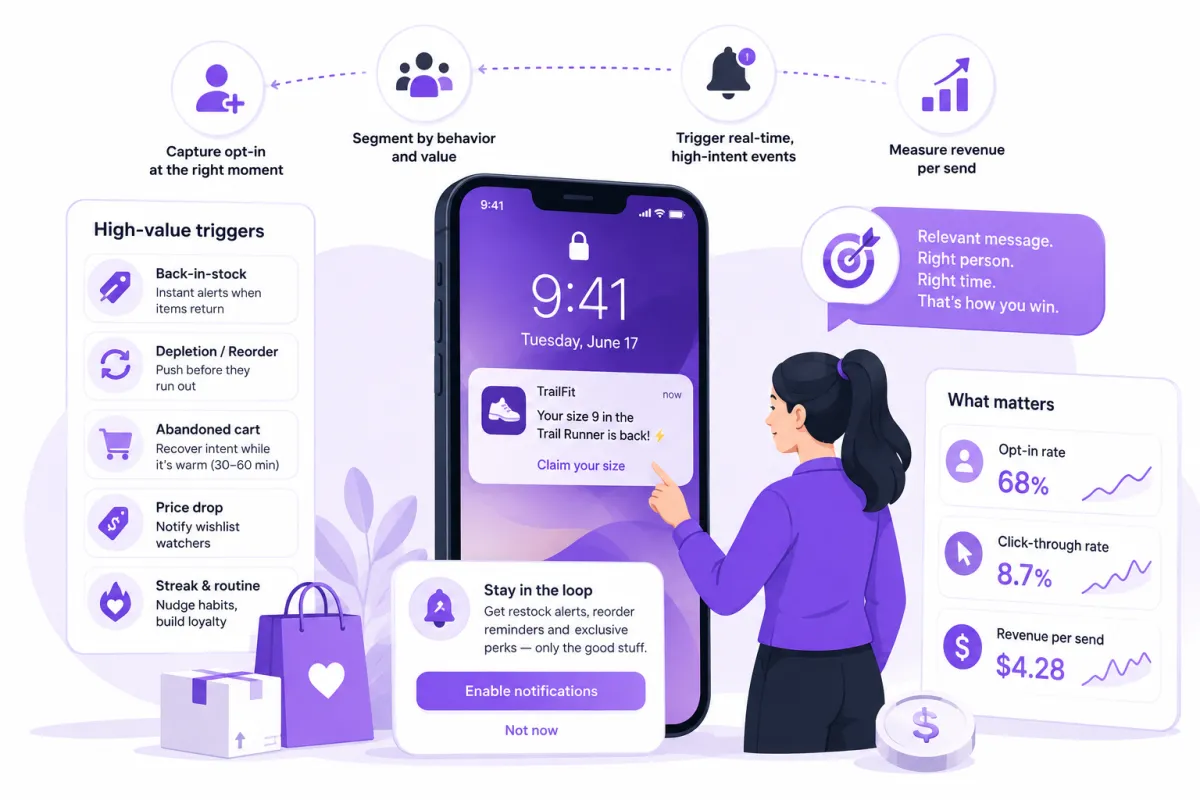
Push notifications are the only retention channel you fully own, that costs nothing per send, and that lands directly on a screen the customer chose to put your app on. Used well, ecommerce push engagement runs many times higher than email. Used badly, it's the fastest way to get your permissions revoked and your icon deleted.
The gap between those two outcomes isn't the channel — it's the strategy. This is the playbook: how to capture opt-ins, segment, fire the high-value triggers, stay disciplined on timing, write copy that earns the tap, and measure what's actually working. It's not a channel comparison (we've covered push vs. email vs. SMS elsewhere) and it's not an objection piece. It's the operating manual.
The single idea underneath all of it: broadcast blasts versus behavior-based push. A blast goes to everyone because you have a sale. A behavior-based push goes to one customer because something true happened — they ran low, they hit a streak, the thing they wanted came back in stock. Blasts train people to ignore you. Behavioral pushes train them to tap. Build the strategy around the second kind.
Capture the opt-in without burning it
You can't push to a customer who never granted permission, and you only get one clean ask. Don't fire the system permission prompt on first launch before anyone sees value — opt-in rates collapse when you ask cold.
- Prime before you prompt. Show a soft in-app screen explaining what notifications they'll get ("we'll tell you the moment your size is back, and when you're due to reorder") before the OS dialog. The OS prompt only appears once; the soft ask can be re-shown.
- Tie the ask to a moment of value. Prompt right after a customer favorites a sold-out item or sets up a routine — the permission now has an obvious payoff.
- Mind the platform gap. iOS requires an explicit grant and tends to sit lower (around the mid-50s percent), while ecommerce apps overall average roughly 68% opt-in. Android opt-in dropped sharply after the Android 13 permission change, so don't assume yesterday's rates.
Segment before you send
The fastest way to kill engagement is to send everyone the same thing. Segment on the data your store already has.
- By behavior: active users, lapsing users, cart abandoners, wishlist watchers, streak-builders.
- By purchase history: what they bought, how often, and when they'll run out.
- By engagement: people who tap your pushes can tolerate more frequency; people who never tap should get fewer, higher-stakes messages or none.
Personalization isn't decoration here — adding the product name, price, or category based on real behavior roughly doubles click-through. Segmentation is what turns a generic channel into a relevant one.
The high-value triggers (in priority order)
These are the behavioral events worth building around. They convert because they arrive when the customer is already primed to act.
- Back-in-stock / restock. The highest-intent trigger you have — someone explicitly wanted a sold-out item. Restock alerts are among the highest-ROI automations in ecommerce, and most purchases land within ~30 minutes of the notification. Fire it the instant inventory returns.
- Depletion / reorder timing. The retention killer feature. If you know a customer's typical cycle, push when they're genuinely running low — not on a calendar guess. This is replenishment done right, and it only works if your app actually tracks usage.
- Abandoned cart. Trigger within 30–60 minutes while intent is warm. Layered recovery programs recapture roughly 15–30% of abandoned carts; push is the mobile-native piece of that stack.
- Price drop / wishlist. Tell watchers the moment something they saved gets cheaper. Pre-qualified intent, near-zero friction.
- Routine and streak nudges. "You're one day from breaking your 14-day streak." These are the pushes that build a habit rather than chase a sale — and habit is what drives the reorder later. (More on designing that loop in habit-forming ecommerce apps.)
Notice the pattern: every one of these fires because of something the customer did or something true about their inventory — not because the marketing calendar said Tuesday.
Timing and frequency discipline
This is where most programs self-destruct. The rule is relevance, not volume.
- Real-time beats scheduled. Behavioral triggers should fire on the event, not batched into a 9 a.m. send. The whole point is arriving at the moment of intent.
- Respect the diminishing-returns curve. For most ecommerce apps, click-through peaks around a low number of pushes per day and falls off fast after — for many brands the sweet spot is roughly one or two genuinely relevant messages. More than that and you're training people to swipe you away.
- Cap broadcasts, not behavior. Promotional blasts need a hard frequency cap. Behavioral triggers police themselves — a reorder push only fires when someone's actually running low, so it's self-limiting by design.
- Honor quiet hours and time zones. A 2 a.m. notification is an uninstall waiting to happen.
Copy that earns the tap
You have a lockscreen line or two. Make it specific and make it act-able.
- Lead with the specific fact. "Your size 9 in the Trail Runner is back" beats "New arrivals are here." Specificity is what signals this is for you.
- Use a real CTA verb. "Reorder now," "Claim your size," "Grab your discount" — never "Click here."
- Deploy urgency honestly. Genuine scarcity (low stock, a real countdown) lifts taps; manufactured urgency on every send erodes trust fast.
- Emojis in the body, not the headline. Ecommerce apps see the highest CTR when emojis sit in the message body — they add personality without looking like spam in the title.
Measure what matters
Track three numbers and let them drive iteration. Vanity sends mean nothing.
- Opt-in rate — your ceiling. Everything downstream is capped by how many people let you reach them, so protect it ruthlessly.
- Click-through rate by segment and trigger — not a blended average. Your back-in-stock CTR and your blast CTR are different planets; reporting them together hides the truth. Note that adding a relevant image can lift ecommerce push CTR by roughly a point.
- Revenue per send — the only number that pays the bills. It instantly exposes blasts that look "engaging" but convert nobody, and quiet behavioral triggers that quietly print money. Automated, triggered pushes routinely drive a wildly disproportionate share of push-attributed orders relative to their send volume — that's your signal to do more of them.
A/B test send times, copy, and segments continuously. The winning configuration is store-specific; the discipline of testing is universal.
Put it together
A great push strategy isn't a clever calendar — it's a system wired to customer behavior. Capture the opt-in at a moment of value, segment honestly, fire the high-intent triggers in real time, cap your blasts, write specific copy, and measure revenue per send by trigger. Do that and push becomes your strongest retention channel. Skip it and you'll join the brands wondering why everyone turned notifications off. (If you're worried about the latter, we've addressed it directly in do push notifications annoy customers.)
The catch: behavior-based push needs an app built around behavior worth notifying about — usage, progress, depletion. Drop your Shopify URL into Fastshot and see a free working app preview — with a behavior-based push system already wired in — in 48 hours.
Frequently asked questions
How often should I send push notifications? As often as you have something genuinely relevant to say. For most ecommerce apps, click-through peaks at roughly one to two relevant pushes a day and drops fast beyond that. Cap promotional blasts hard; behavioral triggers like reorder and restock are self-limiting because they only fire on a real event.
What's the difference between broadcast and behavior-based push? A broadcast goes to everyone because you have a sale; a behavior-based push goes to one customer because something true happened — they're running low, an item restocked, a streak is at risk. Behavioral pushes convert far better because they arrive at the moment of intent.
Which push notifications convert best for ecommerce? Back-in-stock alerts and depletion-timed reorder reminders are the highest-intent triggers, followed by abandoned cart (sent within 30–60 minutes) and price-drop alerts to wishlist watchers. They work because they're tied to real customer behavior, not the marketing calendar.
See your app before you commit
Drop your Shopify store URL into Fastshot and get a free working app preview — built around your retention loop — in 48 hours. No card, no engineering.
Get my free preview →