
How a Mobile App Lowers Your Customer Acquisition Cost
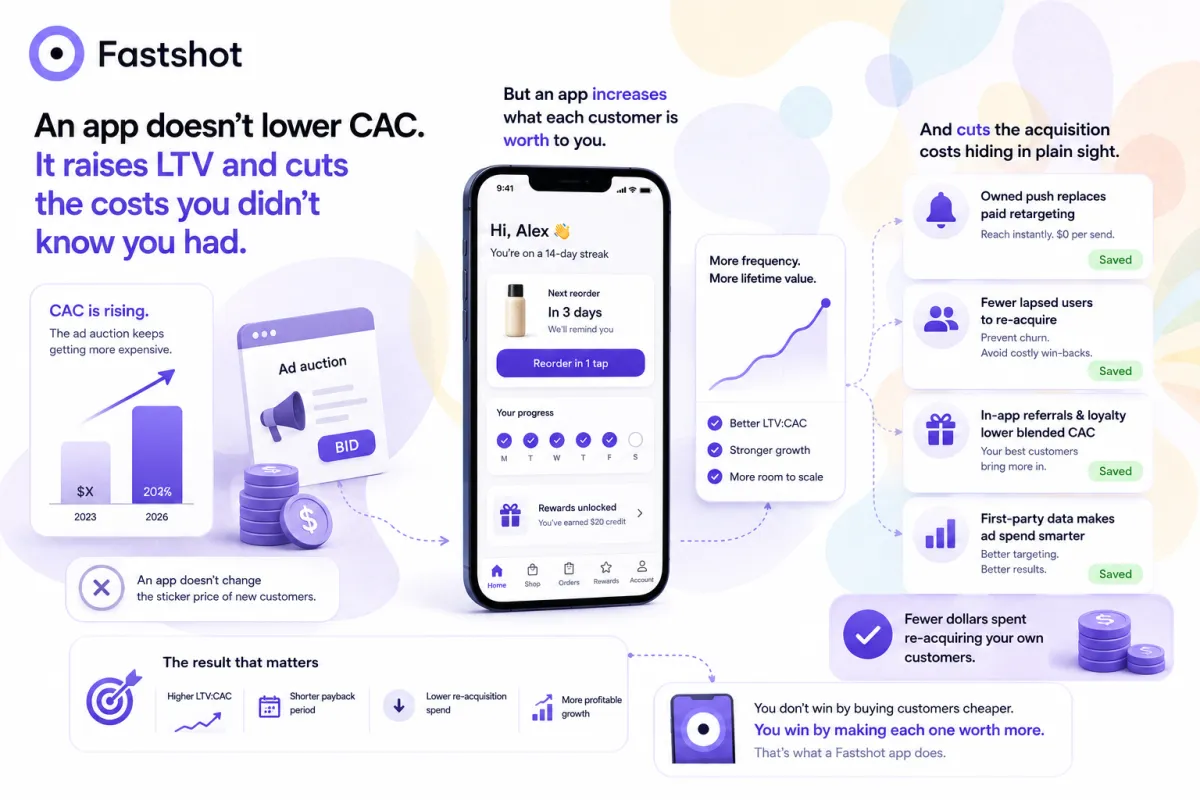
Let's start with a claim you'll see in a lot of app-builder marketing, and then take it apart: a mobile app lowers your customer acquisition cost. It's a tempting line because CAC is the number keeping every Shopify operator up at night. It's also, taken literally, not true. An app does almost nothing to make a brand-new, never-heard-of-you stranger cheaper to acquire — that price is set by an ad auction you don't control, and in 2026 that auction has only gotten more expensive.
So if an app doesn't cut the cost of the next new customer, why do experienced operators keep saying it fixes their acquisition economics? Because they're describing something more useful than a literal CAC reduction. An app doesn't make customers cheaper to buy — it makes each customer you've already bought worth more. That shifts the ratio that actually governs whether you can scale profitably, and it quietly removes a stack of second-order costs you're currently paying to re-reach people you already own.
This piece reframes the whole thing honestly: why CAC itself barely moves, why LTV:CAC is the number that matters, and the specific second-order acquisition costs an app erases.
CAC is rising, and an app doesn't touch the sticker price
First, the bad news, so we're grounded in reality. Acquisition is getting more expensive across the board. Shopify's 2026 commerce research put average merchant CAC up around 16% year over year, and DTC operators report acquisition costs climbing roughly 40% since 2023 — with the large majority of subscription brands saying it costs more to acquire than it did last year. Ad inventory is finite, competition isn't, and the auction reprices accordingly.
Nothing about installing a mobile app changes that auction. The cost to put your ad in front of a cold prospect, win the click, and convert the first order is what it is. If a vendor tells you an app "lowers CAC," push on it — the literal cost-per-acquisition of a new customer is almost entirely outside the app's reach. Pretending otherwise sets you up to measure the wrong thing and conclude the app failed.
The number that actually moves: LTV:CAC
Here's the reframe. CAC is only half of an equation, and it's the half you don't control. The number that decides whether you can grow profitably is the ratio of lifetime value to acquisition cost — and an app moves the numerator hard.
- The consensus floor is roughly 3:1. Most operators target around three dollars of lifetime value for every dollar of CAC. Below that, scaling paid acquisition burns cash; comfortably above it, every new customer pays for the next one.
- You can't reliably shrink the denominator, so grow the numerator. Since CAC is set by the market, the durable lever is LTV. Double the value of each acquired customer and your ratio doubles — same ad spend, same first-order cost, far healthier unit economics.
- A better ratio lets you afford more acquisition. This is the part that loops back to growth: when LTV:CAC improves, the ceiling on what you can profitably bid rises. You can outbid competitors for the same customer because you'll earn more from them. So an app doesn't lower CAC — it earns you the right to spend more on it.
How does an app raise LTV? By raising purchase frequency. A usage-driven app — routines, progress tracking, depletion-timed reorders — gets your best customers buying sooner and more often, and frequency compounds across a customer's lifespan. That's the same mechanism that makes the app incremental rather than cannibalizing: it grows demand instead of relocating it.
Where an app does cut real acquisition costs
"CAC doesn't move" is true for the headline number — and misleading about your total acquisition budget. A surprising share of what you book as "acquisition" spend is actually spent re-acquiring people you already had. An app erases several of those line items:
- Owned push replaces paid retargeting. Retargeting a known customer through Meta or Google means paying the auction again to reach someone you already paid to acquire. A push notification to an installed app costs effectively nothing per send and lands without a middleman. Shift that re-engagement off paid media and you've cut real spend — see how push stacks up against email and SMS for the channel-by-channel math.
- Less re-acquisition of lapsed buyers. The average store loses 70%+ of customers after the first order, and winning a lapsed customer back through ads costs roughly what acquiring them did the first time. An app that keeps customers in a habit loop simply lets fewer of them lapse — every churn you prevent is a re-acquisition cost you never pay. This is the core of escaping the DTC retention plateau.
- In-app referral and loyalty lower blended CAC. A loyal, engaged app user is your cheapest acquisition channel for the next customer. Referral and loyalty mechanics sitting in the app turn your best buyers into a word-of-mouth engine, pulling down blended CAC without buying a single extra impression.
- First-party data sharpens every dollar you do spend. Behavioral signal from the app — what people use, when they reorder — makes your paid targeting and lookalikes smarter, so the ad spend you keep works harder. Indirect, but real.
None of these is "CAC went down" in the literal sense. All of them mean fewer dollars spent re-reaching people you already own, which is the budget line most brands never scrutinize.
How to think about the math
Stop benchmarking an app against new-customer CAC; you'll always be disappointed, because that's not the job. Benchmark it against the ratio and the second-order spend.
Track LTV:CAC before and after the app cohort matures. Track how much retargeting and win-back spend you can cut once owned push is carrying re-engagement. Track payback period — the months it takes to recover CAC plus second-order LTV — and watch it shorten as repeat purchases arrive sooner. If LTV:CAC climbs and your retargeting line shrinks, the app paid for itself, regardless of what the new-customer CAC number did.
The mindset shift is the whole point: you don't win acquisition by buying customers cheaper than your competitors. You win by being able to pay more for the same customer because each one is worth more to you. That's what an app buys you.
The honest bottom line
A mobile app won't lower the price of your next new customer — that's set by an auction you don't control, and in 2026 it's rising. What an app does is raise the value of every customer you've already acquired, improve LTV:CAC, and erase the retargeting and win-back spend you're quietly paying to re-reach your own people. The result reads like cheaper acquisition on your P&L, even though the real mechanism is retention.
Curious what that would do to your numbers? Drop your Shopify URL into Fastshot and see a free working app preview — built around your category's retention loop — in 48 hours.
Frequently asked questions
Does a mobile app actually lower CAC? Not the literal cost to acquire a new customer — that's set by the ad auction, which keeps rising. What an app lowers is second-order acquisition cost: it replaces paid retargeting with owned push, reduces how many lapsed customers you have to re-acquire, and improves LTV:CAC so each acquired customer is worth more. The headline CAC number barely moves; your effective economics do.
What's a healthy LTV:CAC ratio, and how does an app help? The consensus floor is around 3:1 — roughly three dollars of lifetime value per dollar of acquisition cost. An app raises the LTV side by lifting purchase frequency through usage-driven features, which improves the ratio without you needing to win a cheaper ad auction.
Why does retargeting count as acquisition cost? Because you're paying the ad auction a second time to reach someone you already acquired. Every retargeting impression and win-back campaign is money spent re-buying attention you used to own. Owned push from an app reaches those same customers at near-zero marginal cost, which is why it cuts real spend.
See your app before you commit
Drop your Shopify store URL into Fastshot and get a free working app preview — built around your retention loop — in 48 hours. No card, no engineering.
Get my free preview →