
Will a Mobile App Cannibalize My Shopify Web Sales?
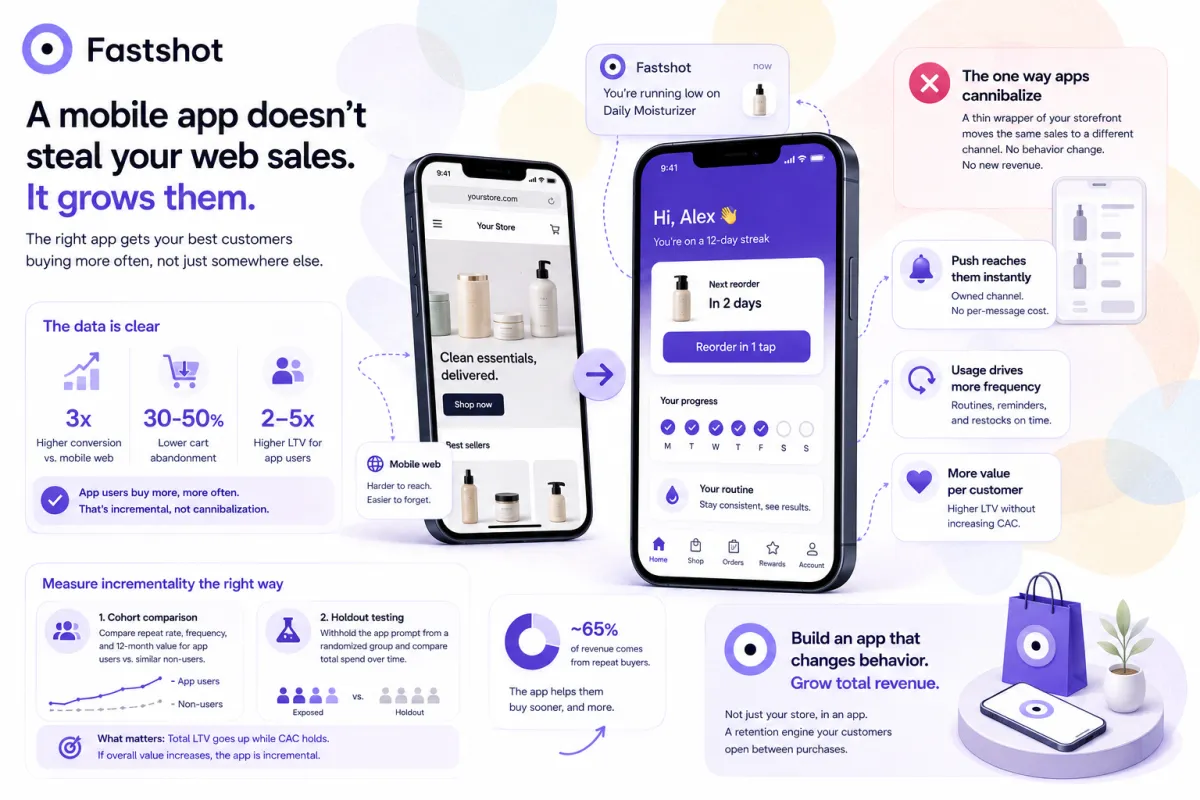
It's the most reasonable objection to building a mobile app, and the one that quietly kills most projects before they start: if my best customers just switch from my website to my app, I haven't grown anything — I've spent money to move the same revenue from one bucket to another. Zero-sum. A vanity channel. A cost with no payoff.
It's a smart fear, and it deserves a real answer rather than a brochure. So here's the honest version. The customers who actually adopt an app are not a random slice of your traffic — they are your most loyal, highest-frequency, highest-LTV repeat buyers. The app doesn't take revenue from those people. It changes how often they come back, how reachable they are, and how long they stay — and those are the inputs that grow total lifetime value. Done right, an app is incremental. Done lazily, it's the cannibalization machine you're afraid of.
This piece walks through why the cannibalization story is mostly wrong, which customers self-select into the app, the one way to build an app that does cannibalize, and how to measure incrementality honestly instead of taking anyone's word for it.
Why "cannibalization" is the wrong mental model
The cannibalization worry assumes a customer's demand is fixed — that a person who would have bought once on the web now buys once in the app, and nothing changes except the channel. That's the part that's wrong. Demand isn't fixed; it responds to friction, reminders, and habit.
A mobile app changes all three. App checkout is faster, so more carts convert. The brand sits on the home screen instead of buried in a browser, so the customer thinks of you more often. And you can reach them by behavior — a depletion-timed reminder, a restock alert — without re-paying for the impression. Industry data consistently shows apps converting roughly 3x higher than mobile web, with materially lower cart abandonment and notably higher repeat-purchase rates among app installers. The realistic read on those numbers isn't "the app stole a web sale." It's "the same customer bought more times than they otherwise would have."
The retail research on this is blunt: properly integrated apps tend to produce a halo across channels rather than a transfer between them — app users visit and purchase more often than non-app users, not less. The channels feed each other.
The customers who actually adopt your app
Nobody downloads an app for a brand they bought from once and forgot. App installs come from people who already like you. That self-selection is the whole argument, so it's worth sitting with.
- Installers are your loyalists, not your tire-kickers. The person who searches your name in the App Store has already decided you're worth a slot on their phone. These are repeat buyers and brand fans — the cohort that already drives the majority of your revenue.
- They were going to keep buying regardless — the question is how often. This is the key shift. The app doesn't conjure loyalty from a cold customer; it raises the frequency of customers who were already coming back. Roughly 65% of ecommerce revenue comes from repeat buyers, and the fifth order tends to run well above the first. Compressing the time between those orders is where the lift lives.
- They're the segment worth a push-reachable channel. Reported figures put app-user lifetime value several times higher than web-only shoppers. Whether that's 2x or 5x in your store, the direction is consistent: the people who adopt are the people most worth a direct, owned line of contact.
So even in the worst-case framing — every app sale is a sale that "would have happened anyway" — you've still moved your most valuable customers onto a faster, owned, push-reachable channel where their next purchase comes sooner. That's not a transfer. That's frequency.
The one way an app does cannibalize
Here's where intellectual honesty matters: the cannibalization fear is real for one specific kind of app. If you ship a thin wrapper around your storefront — same catalog, same checkout, same experience, just in an app shell — then yes, you've mostly built a more expensive front door to the same store. Nothing about the customer's behavior changes, so there's no new revenue to point to. You've just relocated demand and added a build cost.
The apps that are genuinely incremental do something the web doesn't. They're built around how customers use the product, not just how they buy it — a routine or protocol to follow, progress and streaks that make the value visible, and reorder triggers timed to real depletion instead of a generic calendar. That usage-driven loop is what raises frequency, and frequency is what makes the app additive instead of a sideways shuffle. If your app gives a customer a reason to open it on days they aren't buying anything, it will eventually grow what they buy. If it doesn't, it won't. It's that clean.
How to measure incrementality honestly
Don't trust the vendor's chart and don't trust your gut — measure it. Attribution dashboards will happily credit the app for sales that would have happened anyway, which is exactly the illusion you're trying to avoid. Two approaches cut through it:
- Cohort comparison. Track repeat-purchase rate, order frequency, and 12-month value for customers who adopt the app versus comparable customers who don't. Watch the trend after install, not the absolute level — installers start higher because they're loyalists, so the honest question is whether their frequency rises after adoption.
- Holdout testing. Withhold the app prompt from a randomized slice of eligible customers and compare total spend across the full group over time. A geo or audience holdout is the closest thing to a clean read on lift, and DTC incrementality programs increasingly treat this as standard practice rather than a one-off audit.
- Total revenue, not channel revenue. The number that settles the argument isn't "app sales" — it's whether your overall repeat rate and per-customer value went up. If total LTV rises while CAC holds, the app is incremental, full stop. (This is the same logic behind why an app can improve your acquisition economics without lowering the headline cost of a new customer.)
Run it for a couple of quarters and the data answers the question for you. In practice, brands that build a real usage loop see the app cohort's frequency climb rather than hold flat — which is the signature of incremental demand, not a transfer.
So, will it cannibalize your web sales?
If you build a storefront-in-an-app, partly — and you'll struggle to prove it earned its keep. If you build a retention tool your loyalists actually open between purchases, no: it shifts your best customers onto a higher-frequency, owned channel and grows their total lifetime value without touching CAC. The cannibalization question is really a what-kind-of-app question wearing a disguise.
Want to see which one you'd be building? Drop your Shopify URL into Fastshot and see a free working app preview — built around your category's usage loop — in 48 hours.
Frequently asked questions
Do app users just stop buying on my website? Usually not — they tend to use both, and total purchases go up. App users skew toward your most loyal, highest-frequency buyers, and a well-built app raises how often they buy rather than simply relocating a web order. The honest test is whether total per-customer value rises, not which channel a given sale lands in.
How do I prove the app is incremental and not just moving sales? Use a holdout: withhold the app prompt from a randomized slice of eligible customers and compare total spend across the whole group over a couple of quarters. Pair that with a cohort view of repeat rate and frequency before versus after install. If overall LTV rises while CAC holds steady, the lift is real.
What kind of app actually adds revenue instead of cannibalizing? One built around product usage — routines, progress tracking, and depletion-timed reorders — not a thin wrapper around your existing storefront. A usage-driven app gives customers a reason to open it on non-purchase days, which raises frequency and makes the app additive. A storefront clone mostly relocates demand you already had.
See your app before you commit
Drop your Shopify store URL into Fastshot and get a free working app preview — built around your retention loop — in 48 hours. No card, no engineering.
Get my free preview →