
How to Build a Habit-Forming Ecommerce App (Usage → Habit → Reorder)
Think about the products you reorder without ever deciding to. Your coffee. Your supplements. Your skincare. You don't reorder them because a brand reminded you — you reorder because they're part of a routine. You've built a habit, you notice when you're running low, and replacing them is automatic.
Now think about the products you bought once and never again. Nothing was wrong with them. They just never became part of how you live.
That contrast is the entire game in ecommerce retention. Repeat purchases are a byproduct of habits, and habits are something you can design into a product experience. This is what a habit-forming — or behavior-driven — ecommerce app does. Here's the loop behind it and how to build one.
The loop: Usage → Habit → Reorder
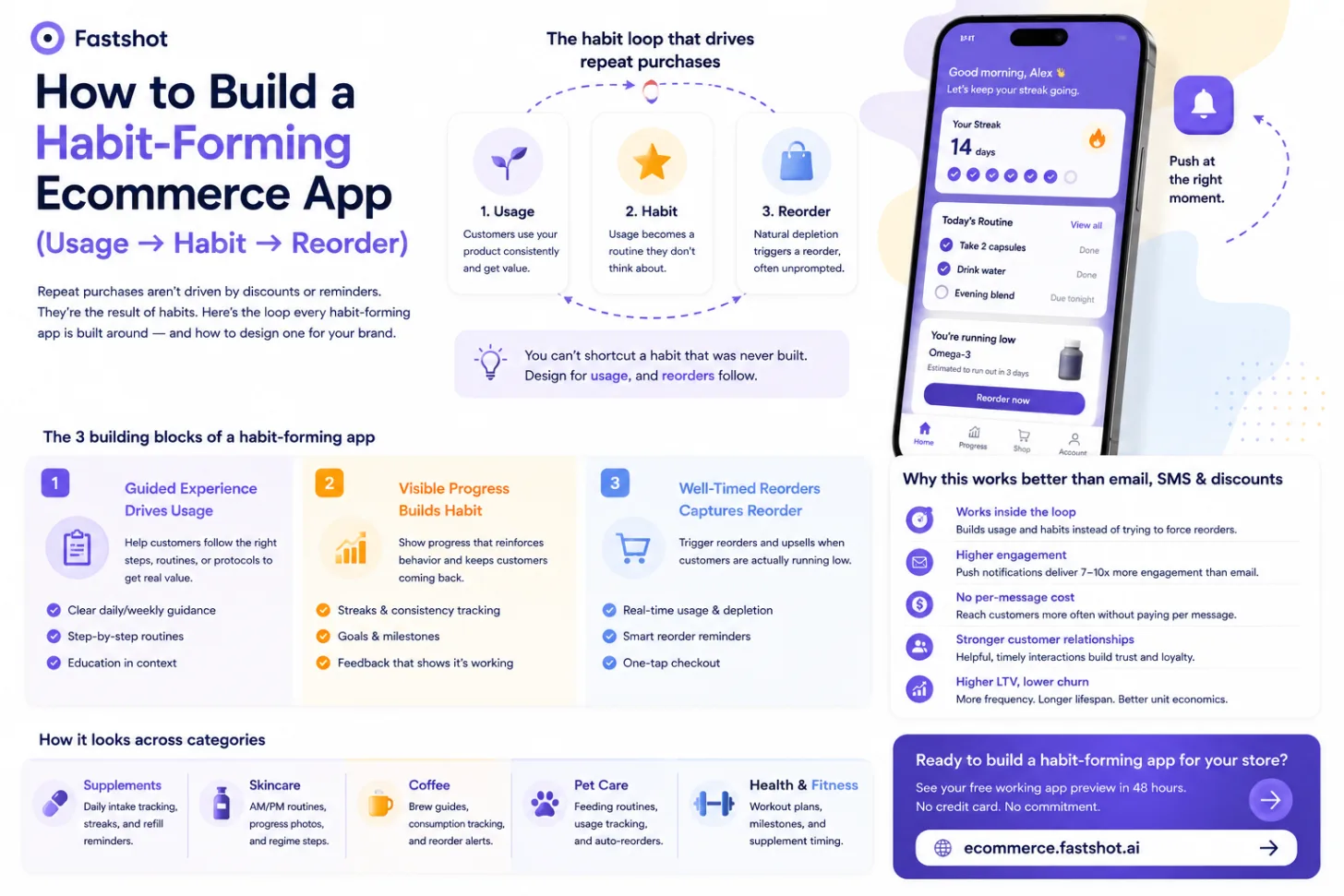
Every durable repeat-purchase business runs on the same three-stage loop:
Usage → Habit → Reorder
- Usage: the customer actually uses what they bought, consistently.
- Habit: consistent usage hardens into a routine they don't think about.
- Reorder: the habit creates natural depletion and demand — they reorder, often unprompted.
Most brands try to skip straight to the reorder with discounts and reminders. It doesn't work, because you can't shortcut a habit that was never built. The reorder is the output of the loop, not an input you can buy. If you want more reorders, you have to engineer more usage. Everything below is about doing exactly that.
The three building blocks of a habit-forming app
A storefront can't build a habit — it can only sell. A habit-forming app adds three things on top of the storefront, each targeting one part of the loop.
1. A guided experience (drives usage)
Most customers don't get full value from a product because they don't use it correctly or consistently. A guided experience fixes that: it walks customers through the right steps, routines, or protocol for your category, so the product works and they feel it working.
- A supplement brand guides a daily intake routine.
- A skincare brand guides an AM/PM regimen.
- A coffee brand guides brewing methods and a reorder rhythm.
- A fitness or wellness brand guides a program or protocol.
When the product is used correctly, it delivers results — and results are what make a customer want to keep going.
2. Visible progress (builds habit)
Humans repeat behaviors they can see working. Tracking, streaks, and feedback turn an invisible routine into something with momentum:
- A streak the customer doesn't want to break.
- Progress toward a visible goal.
- Feedback that reinforces "this is working, keep going."
This is the engine that converts a few weeks of usage into a genuine habit. It's also why a habit-forming app outperforms a storefront with the same products — the storefront sells the product, the app makes the customer stick with it.
3. Well-timed reorders (captures the reorder)
The third block closes the loop. Instead of blasting promos on a generic calendar, a behavior-driven app triggers replenishment and upsells based on real depletion — when the customer is genuinely running low based on how they actually use the product. Paired with push notifications (a channel you own, with far higher engagement than email) and one-tap checkout, the reorder becomes nearly frictionless. The customer was going to run out anyway; the app simply meets them at the exact moment they need to restock.
Why habit loops beat email and discounts
The standard playbook — more email, more SMS, more discounts — operates entirely outside the loop. It tries to communicate customers into reordering. But a customer who isn't using the product has no reason to reorder, so the messages get ignored, and the discounts just erode margin while training customers to wait. (This is the same reason retention is a product problem, not a marketing one.)
A habit-forming app works inside the loop. It doesn't nag customers to come back; it gives them a reason to — by making the product work, making progress visible, and showing up exactly when they run low. The result is more consistent usage, shorter time to reorder, and higher lifetime value — without raising acquisition costs.
How to design the loop for your category
The loop is universal; the specifics depend on what you sell. To design yours:
- Define the core usage behavior. What does "using your product correctly and consistently" look like day to day?
- Build the guided experience around it. Map the steps, routine, or protocol that gets customers to that behavior.
- Decide what progress to make visible. What can customers track or streak that reflects real value?
- Model real depletion. Based on usage, when does a customer actually run low — and what's the right reorder or upsell at that moment?
- Wire it into a channel you own. Deliver the guidance, progress, and reorder triggers through push and an app the customer checks daily.
That last point is why an app — not an email flow — is the right vehicle. The loop needs a place customers return to regularly, where guidance, progress, and reorders live together. A storefront in a frame can't do it; an app built around your category's behavior can.
How to turn usage into repeat purchases
Stop trying to remind customers into reordering and start designing the habit that makes reordering inevitable. Build the guided experience that drives usage, the visible progress that builds the habit, and the well-timed triggers that capture the reorder — and the repeat purchases follow as a consequence.
That's exactly what Fastshot builds. Drop your Shopify URL and see a free working preview of your behavior-driven app — mapped to your category's usage loop — in 48 hours.
Frequently asked questions
What makes an ecommerce app "habit-forming"? It's built around a usage loop — guiding correct, consistent product use, showing visible progress to reinforce the routine, and triggering reorders at real depletion — rather than just displaying products.
Does this only work for subscription products? No. Any product with a natural reorder cycle — consumables, replenishables, routine-based goods — benefits. The loop creates the reorder behavior that subscriptions try to lock in, without forcing customers into a commitment.
How is this different from a loyalty program? Loyalty points are an incentive bolted onto buying. A habit-forming app changes the underlying behavior — usage — so customers want to come back on their own, which is more durable than points.
See your app before you commit
Drop your Shopify store URL into Fastshot and get a free working app preview — built around your retention loop — in 48 hours. No card, no engineering.
Get my free preview →