
BFCM Retention: How to Keep the Customers You Win on Black Friday
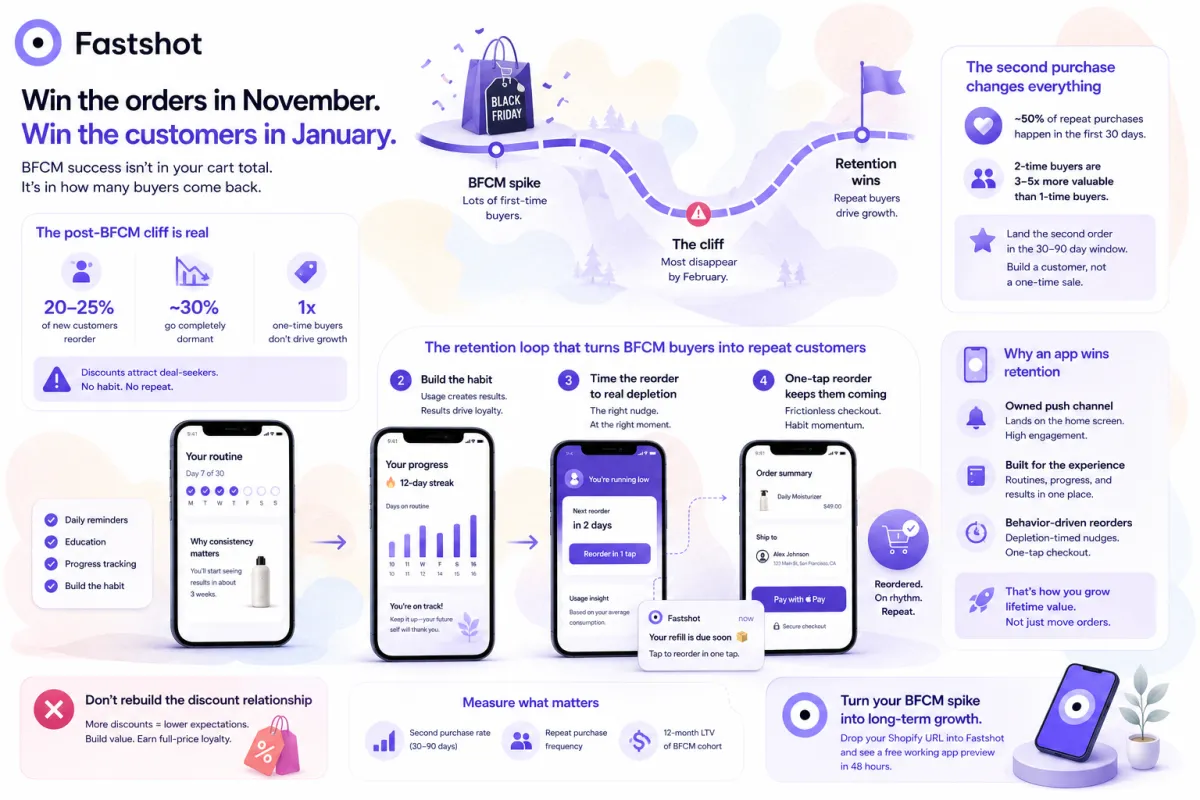
Most brands measure BFCM the wrong way. They count the orders that landed over the weekend and call it a record. But a BFCM order from a deal-seeker who never comes back isn't growth — it's a one-time spend you bought at your steepest discount of the year. The real scoreboard runs in January, when you find out how many of those buyers became customers.
The numbers are sobering. New-customer repeat rates sit in the low twenties, and a large chunk of first-time buyers — close to a third in some analyses — go completely dormant after the first order. BFCM makes that worse, not better, because the discount itself selects for the least loyal demand: people who came for 40% off and will leave for 41% off somewhere else. You acquire a flood in November and watch most of it drain out by February. That's the post-BFCM cliff.
This article is about not falling off it. Not with another discount or another email blast — those are the tools that built the problem — but by converting BFCM buyers into repeat customers the only way that actually compounds: getting them to use the product, hitting the first reorder at the right moment, and owning the channel that makes both possible. Here's how.
Why BFCM buyers churn
Understanding the cliff is the whole job, because the cliff has a cause and the cause is fixable.
- The discount selects for disloyalty. A deep first-order discount attracts buyers whose primary relationship is with the deal, not the brand. When the discount goes away, so do they.
- You trained a price expectation. Acquire someone at 40% off and you've anchored them there. The next full-price email reads as a markup. This is how discounting quietly poisons your repeat economics.
- There's no second behavior. A one-time buyer bought a thing. A repeat buyer has a habit. BFCM is great at producing the first and does nothing for the second on its own.
- The owned channel is weak. Email open rates are mediocre and SMS is expensive and easy to mute. If your only post-sale touch is a discount in a crowded inbox, you've already lost most of the cohort.
The fix isn't to communicate harder. It's to change what happens after the box arrives. Retention is a product problem, not a messaging one — a point we make at length in why Shopify retention is a product problem.
The math that makes retention worth it
The reason this is worth real effort: the second purchase is the single highest-leverage move in your whole funnel. Roughly half of all repeat purchases happen in the first 30 days and three-quarters within 90 — and a customer who buys twice is dramatically more likely to buy a third, fourth, and fifth time. Two-time buyers carry several times the lifetime value of one-timers.
So the BFCM cohort isn't a lost cause — it's the largest pool of first-time buyers you'll ever acquire in a single window, sitting right at the most decisive moment of the retention curve. Bend that curve even slightly and the BFCM you "lost money on" becomes the most profitable cohort of the year. The leverage is enormous; almost nobody captures it because they're still optimizing the November order. (More on the broader CLV math in increasing customer lifetime value on Shopify.)
Onboard the buyer into using the product
Here's the move almost no one makes: treat the post-purchase moment as the start of an onboarding flow, not the end of a sale. A customer who never uses the product correctly never feels its value, and a customer who never feels value has no reason to reorder — no matter how many emails you send.
So guide the usage. Walk the buyer through the routine, protocol, or regimen your category actually requires:
- A supplement has a daily intake routine and a "you'll notice it around week three" arc.
- Skincare has an AM/PM regimen and a timeline before results show.
- Coffee or consumables have a brewing method and a rhythm of use.
- Anything with a learning curve has a first-week experience that decides whether it becomes a habit or a drawer item.
When the product gets used correctly and consistently, it works — and that is what makes someone want to keep going. This is the front half of the Usage → Habit → Reorder loop, and it's the entire foundation of a habit-forming ecommerce app. Discounts can't manufacture it. Usage does.
Time the first reorder to real depletion
Once usage is happening, the reorder is a timing problem, not a persuasion problem. The customer is going to run low; your only job is to show up at that exact moment with one-tap reordering — not three weeks early (ignored as spam) or three weeks late (they've already bought elsewhere or forgotten).
Generic discount blasts on a marketing calendar miss this by design — they fire when you want a sale, not when the customer is actually out. A behavior-driven reorder trigger fires when depletion is real, based on how the customer uses the product. Get the timing right and the reorder feels like a service, not a sell. That's how you land the all-important second purchase inside the 30-to-90-day window where it matters most — and once someone has reordered once on rhythm, the habit largely sustains itself.
Make the app your owned channel
All of this needs a home. Email and SMS can't run an onboarding flow, can't show progress, and can't deliver a perfectly timed reorder nudge to a place the customer checks daily. An app can.
The app is what makes the retention motion possible after BFCM:
- It owns the channel. Push lands on the home screen, with engagement far above email — and you're not renting access through an inbox algorithm or paying per SMS.
- It holds the guided experience. Onboarding, the routine, progress tracking, and streaks all live in one place the customer returns to.
- It triggers reorders on real behavior. Depletion-timed push plus one-tap checkout turns the second purchase into the path of least resistance.
This is the difference between an app that's a storefront in a frame and one that's a retention tool. The storefront sold the BFCM order. The retention tool keeps the customer.
Don't rebuild the discount relationship
A warning, because it's the easiest mistake to make in December: the instinct after BFCM is to send the cohort another discount to "reactivate" them. Resist it. Every follow-up discount deepens the price anchor and confirms to the customer that your brand is only worth buying on sale. You're not retaining them — you're renting them, at a worse and worse rate each time.
The durable post-BFCM relationship is built on value the customer feels from using the product, plus a reorder that arrives exactly when they need it. Save the discounts for acquisition where they belong, and let usage carry retention. Brands stuck re-discounting their own customers are usually the ones describing a retention plateau they can't explain — this is why.
The post-BFCM playbook in one line
Win the orders in November; win the customers in January. The BFCM spike only becomes growth if you onboard buyers into real usage, hit the first reorder at genuine depletion, and run all of it through an owned channel instead of a discount treadmill. That's a product motion, and it's exactly what we build. (For the acquisition side of the same weekend, see our BFCM mobile app marketing guide.)
Drop your Shopify URL into Fastshot and see a free working app preview — built around the retention loop your category needs — in 48 hours.
Frequently asked questions
Why do BFCM customers churn faster than other customers? Because a deep first-order discount selects for deal-seekers whose relationship is with the price, not the brand, and it anchors a price expectation that makes future full-price offers feel like markups. Combine that with no second usage behavior and a weak owned channel, and most of the cohort goes dormant within weeks unless you actively change the post-purchase experience.
What's the most important metric to track after BFCM? The percentage of BFCM buyers who make a second purchase within 30 to 90 days. Half of all repeat purchases happen in the first 30 days, and a two-time buyer is far more likely to keep buying — so second-purchase rate, not total November orders, is the number that predicts whether the cohort becomes profitable.
Should I send my BFCM buyers a discount in January to bring them back? Generally no. Another discount deepens the price anchor and trains the customer to only buy on sale, which erodes the relationship you're trying to build. The more durable move is to onboard them into using the product and time a reorder to real depletion through an owned channel like an app, so the repeat purchase comes from habit rather than a coupon.
See your app before you commit
Drop your Shopify store URL into Fastshot and get a free working app preview — built around your retention loop — in 48 hours. No card, no engineering.
Get my free preview →