
Why DTC Retention Plateaus (When Email, SMS, and Discounts Stop Working)
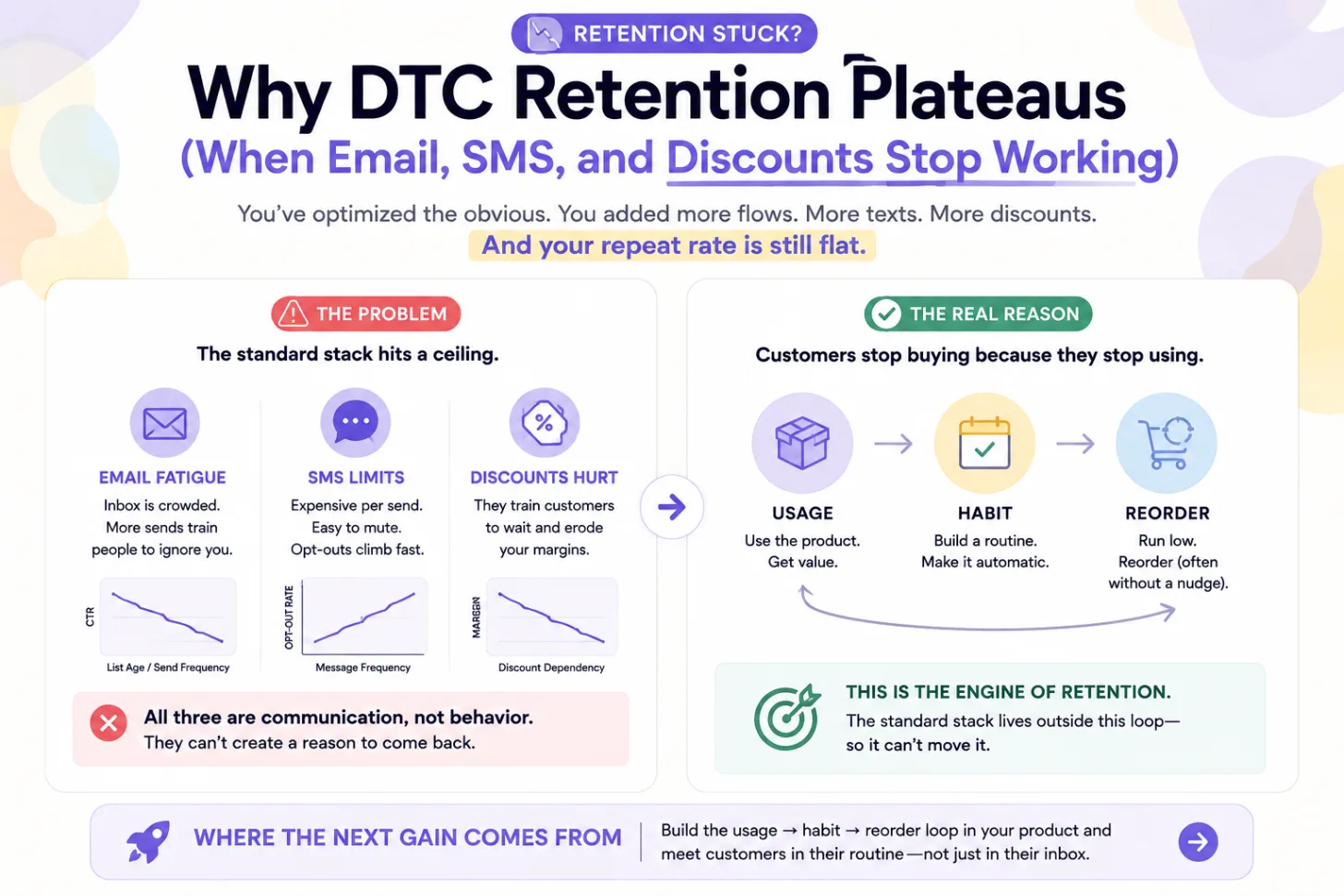
Somewhere between $50K and $100K a month, the growth problem changes shape. Acquisition still works. Your first-purchase rate is fine — the product converts. But the repeat curve has gone flat, and the levers that used to move it (a new flow, a better-timed text, a sharper second-order discount) barely register anymore. You add the tactic, you get a fraction of the bump you used to, and the line keeps drifting sideways.
Here's the uncomfortable part: you're probably not missing a tactic. You've hit a ceiling that's built into the tools themselves. This is about why that ceiling exists — and where retention actually comes from once you've maxed out the standard stack.
You've already optimized the obvious — and the curve still flattened
Walk through what you've almost certainly already done. Segmented Klaviyo flows: welcome, browse abandon, abandoned cart, post-purchase, winback. SMS layered on for the high-intent moments. A discount ladder to pull the second and third order. Each one gave you a real lift the first time. Each one has since flattened.
That pattern — big gain, then diminishing returns — isn't a sign you implemented it wrong. It's the signature of a channel reaching its natural limit. The fifth flow can't do what the first one did, because the first one already captured the customers who were going to respond to being reminded. Optimizing harder inside a maxed-out system returns less and less.
Why email, SMS, and discounts have a ceiling
Each of the three pillars hits its wall for a specific, structural reason.
Email fatigue is mathematical
Click-through rates drift down as your list ages and your send frequency climbs. The inbox is crowded, promotional mail gets filtered, and the majority of sends are never acted on. You can segment and re-time all you want, but you can't out-send the ceiling — past a point, more email just trains people to ignore you.
SMS is expensive and easy to mute
Texts get opened, which is why SMS gave you a jump. But you pay per message, so frequency is capped by cost, and opt-out rates climb fast the moment messages feel like marketing rather than service. SMS is built for the occasional high-value moment, not for the steady, daily contact that builds a habit.
Discounts erode the thing you're trying to grow
The second-order discount works until customers expect it — then it stops being an incentive and starts being the price. Every discount trains buyers to wait for the next one and compresses the margin on revenue you'd have earned anyway. You can buy repeat purchases this way, but you're paying for them with the lifetime value you're trying to raise.
What all three have in common: they're communication, not behavior
Step back and the deeper issue comes into focus. Email, SMS, and discounts are all ways to talk to a customer. A message can nudge someone who already has a reason to come back. What it can't do is manufacture a reason that isn't there. When the reason is missing, more communication doesn't create demand — it just raises your cost and your unsubscribe rate.
That's why the plateau feels so stubborn. You're applying communication tools to a problem that isn't a communication problem. (This is the same reason retention is fundamentally a product problem, not a marketing one.)
The real reason the repeat curve flattened
Strip it down and it comes to this: customers stop buying because they stop using the product. The ones who reorder are the ones who built a routine around what they bought — they use it, they run low, they restock, often without being asked. The ones who don't reorder aren't unhappy. The product just never became part of how they live.
Your repeat rate is, more than anything, a measure of how many customers crossed the line from bought it to uses it. And no email flow, no matter how well-timed, moves that line — because usage happens with the product, not in the inbox.
Usage → Habit → Reorder. That's the actual engine of retention, and the standard stack operates entirely outside of it. (Here's how that loop works in detail.)
Where retention comes from after the standard stack
If the channels are maxed out, the next gain isn't another channel — it's the part of the journey you've barely touched: the post-purchase product experience. Helping customers actually use what they bought, showing them their progress, and triggering a reorder at real depletion, all through a channel you own rather than rent.
That's a fundamentally different lever than "send more," and it's the one most brands at your stage haven't pulled — usually because the obvious tool for it (a mobile app) gets dismissed as either un-downloadable or just another storefront. Both of those objections are fair, and both have honest answers worth reading before you write the channel off. (Start with whether anyone would actually download it.)
Want to see what a post-purchase retention loop would look like for your store? Drop your Shopify URL into Fastshot and get a free working app preview — built around the loop your category needs — in 48 hours.
Frequently asked questions
Why did my Klaviyo flows stop improving retention? Diminishing returns. The first flows captured the customers who respond to reminders; additional flows reach fewer of them. Email is also a communication tool, and it can't create a reason to reorder that the product experience hasn't already built.
Are discounts bad for retention? They're a short-term lever with a long-term cost. Discounts train customers to wait for the next promo and compress margin on orders you'd have earned anyway, which lowers the lifetime value you're trying to grow. Useful occasionally; corrosive as a retention strategy.
What repeat purchase rate should a $50K–$100K/month DTC brand expect? It varies widely by category, but many brands plateau somewhere around 20–30%. The ceiling usually isn't a tactics problem — it's how many customers actually use the product consistently enough to reorder.
Is email still worth doing? Yes — for receipts, order updates, education, and winback. Just don't expect it to be your retention growth lever once the flows are built. Its job is communication; retention is driven by what customers do with the product.
See your app before you commit
Drop your Shopify store URL into Fastshot and get a free working app preview — built around your retention loop — in 48 hours. No card, no engineering.
Get my free preview →