
"Why Would Anyone Download Your App?" — An Honest Answer for DTC Brands
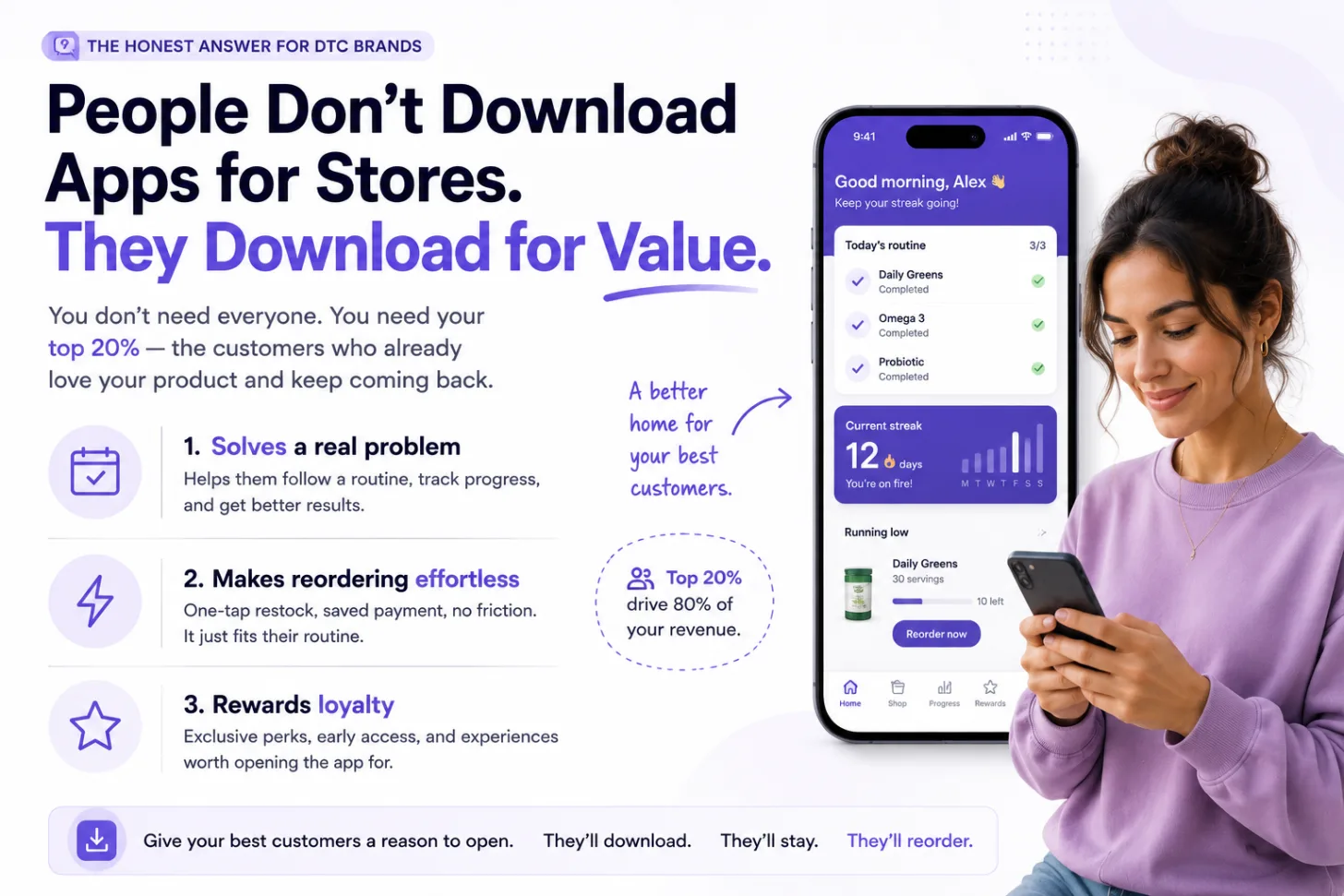
It's the first thing any operator with sense says when mobile apps come up, and it's the correct instinct. Nobody is sitting around wishing they had another shopping app on their phone. If the case for a brand app depends on people wanting one, the case is weak.
So let's answer the objection honestly, with the math — because the honest answer is actually more useful than the hype. It tells you exactly when a brand app is worth building, who it's for, and when you should skip it entirely.
The objection is correct — most customers won't download, and shouldn't
Start by conceding the point fully. The average first-time or one-time buyer will not install your app. Trying to get them to is a waste of money, and if your pitch to them is "download our app to shop," you've already lost — that's just your website with an extra step in front of it.
The mistake isn't doubting that customers will download. The mistake is assuming an app needs mass adoption to be worth it. It doesn't. A brand app isn't a top-of-funnel channel. It's a tool for the customers you already have.
You don't need everyone — you need your top 20%
Here's the reframe that makes the math work. In most DTC brands, a small slice of customers — your repeat buyers — drives the majority of revenue. That cohort is who an app is for. You're not trying to convert your whole email list. You're giving your best customers a better home.
Run your own numbers. Take the share of customers who buy more than once, and the share of revenue they represent. Getting those people onto an app — where reordering is one tap with saved payment, and the experience actively reinforces the habit that brings them back — moves the metrics that matter (repeat rate, lifetime value) without needing a single casual buyer to install anything.
Frame it that way and the download objection mostly dissolves. You were picturing 100% adoption and a low conversion rate. The actual target is high adoption among the 20% of customers who were always going to be your retention base.
Why people actually install a brand app (and it isn't "to shop")
The brands whose apps get downloaded don't sell "an app." They offer a reason a website can't match. In practice, the reasons that earn an install look like this:
- Utility and routine — the app helps customers use the product: follow a protocol, track intake, log progress, stick to a regimen.
- Faster reorders — one-tap restock with saved payment, no re-login, no re-entering shipping details every time.
- Visible progress — streaks, tracking, and feedback give customers a reason to open it between purchases.
- Member perks — early access, app-only drops, and loyalty that lives in one place instead of a forwarded email.
Notice what's not on that list: "browse our catalog." People download tools and routines, not storefronts. The brands that frame their app as "a faster way to shop with us" get ignored; the ones that frame it as "the place you actually use the product" get installed. (That distinction is the whole point of a behavior-driven app.)
When a brand app is worth it — and when it isn't
Because honesty is the point here, the gate runs both ways.
An app is worth it if:
- Your product has real repeat-purchase potential — consumables, replenishables, or anything tied to a routine or protocol.
- You already have a base of repeat customers driving meaningful revenue.
- There's a reason to open it between orders, not just at checkout.
An app probably isn't worth it yet if:
- Your product is genuinely one-and-done with no natural reorder cycle.
- You're very early, with too few repeat customers to form a base.
- You haven't yet found the post-purchase behavior that would make the app useful.
If you're a $50K–$100K/month brand with a plateauing repeat rate and a product people use over time, you're squarely in the first list. (Here's the fuller app-vs-website tradeoff if you're weighing it.)
How to drive the installs that actually matter
You don't run app-install ads at cold traffic — that's where the bad download math comes from. You prompt at the moments your best customers are already engaged and already have a reason:
- Post-purchase, when they've just bought and want to track the order or set up their routine.
- In the box — an unboxing insert that points to what the app does, not that it exists.
- In winback to known repeat buyers — the people most likely to want a faster reorder.
- With an app-only reason — early access, a perk, a feature that only lives there.
Quality of installs beats quantity every time. A thousand casual downloads that never reorder is worse than two hundred repeat customers who now restock in one tap.
Curious whether your customers would actually use one? Drop your Shopify URL into Fastshot for a free working app preview — built around your best customers, not your whole list — in 48 hours.
Frequently asked questions
What's a realistic download rate for a DTC brand app? Don't measure it against your whole customer base — measure adoption among repeat customers, who are who the app is for. A high install rate among your top 20% matters far more than a low rate across everyone.
How do I actually get customers to install my app? Prompt your best customers at engaged moments — post-purchase, in the box, in winback — and give a concrete reason (routine, faster reorders, a perk). Skip cold app-install ads; that's where adoption economics fall apart.
Do I need a big audience for an app to be worth it? No. Because a small share of repeat customers drives most DTC revenue, you only need those customers on the app. The casual buyers can keep using your website.
Will an app cannibalize my website? No — they do different jobs. Your site handles discovery and first-touch traffic; the app is the retention layer for customers you've already won. The best brands run both.
See your app before you commit
Drop your Shopify store URL into Fastshot and get a free working app preview — built around your retention loop — in 48 hours. No card, no engineering.
Get my free preview →