
How to Increase Customer Lifetime Value (LTV) for Your Shopify Store
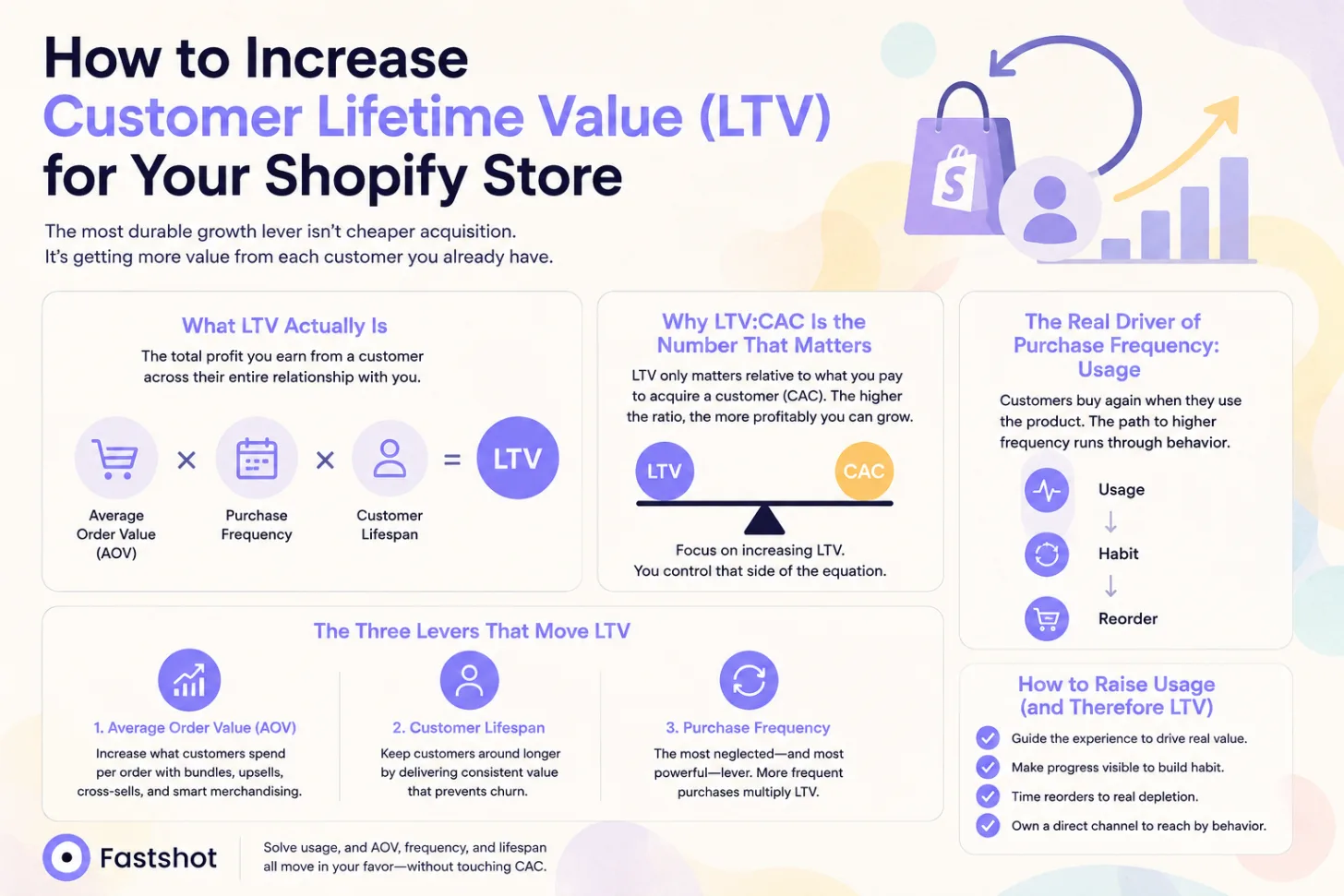
There's a reason experienced operators obsess over lifetime value. Acquisition costs only go up, ad channels only get more crowded, and first-order margins only get thinner. In that environment, the brands that win aren't the ones who acquire customers cheapest — they're the ones who get the most value out of each customer they already have. That's what customer lifetime value (LTV) measures, and raising it is the most durable growth lever you have.
This guide covers what LTV really is, why the LTV-to-CAC ratio is the number that decides whether you can grow profitably, and the three levers that move LTV — including the one most Shopify brands quietly neglect.
What customer lifetime value (LTV) actually is
Customer lifetime value is the total profit you earn from a customer across their entire relationship with you. A simplified way to think about it:
LTV ≈ Average Order Value × Purchase Frequency × Customer Lifespan
Each term is a lever. Raise any of them and LTV goes up. The trap is that most brands pour effort into just one of them.
Why LTV:CAC is the number that matters
LTV doesn't mean much in isolation — it matters relative to what you pay to acquire a customer (CAC). The ratio of the two tells you whether your growth is sustainable. If you spend more to acquire a customer than you'll ever earn back, scaling just loses money faster.
Here's the problem with the way most brands try to fix a weak ratio: they attack CAC. They optimize ad creative, test new channels, chase cheaper traffic. But acquisition costs are largely set by a crowded market you don't control. The side of the ratio you do control is LTV — and it has far more headroom. Doubling LTV is usually more achievable, and more permanent, than halving CAC.
The three levers that increase LTV
Lever 1: Average Order Value (AOV)
Get customers to spend more per order through bundles, upsells, cross-sells, and thoughtful merchandising. AOV is worth optimizing, but it has a ceiling — there's only so much you can add to a single cart before it stops converting.
Lever 2: Customer Lifespan
Keep customers around longer before they churn. This is real, but it's downstream of behavior — customers stay because they keep using and buying, not because you asked them to stay.
Lever 3: Purchase Frequency — the neglected lever
Here's the one most brands underinvest in: how often each customer buys. And it's the lever with the most upside, because it compounds. A customer who buys four times a year instead of once is worth roughly four times as much — without you spending a cent more on acquisition.
The reason frequency gets neglected is that brands don't know how to move it. They try discounts (which train customers to wait, not to buy more often) and email reminders (which mostly get ignored). Neither works, because frequency isn't a messaging problem.
The real driver of purchase frequency: usage
Customers buy again when they use the product. The path to higher frequency runs through behavior:
Usage → Habit → Reorder
A customer who uses your product consistently builds a routine around it, notices when they're running low, and reorders — often without being prompted. A customer who bought once and never built that habit won't reorder no matter how many emails you send. So if you want to raise purchase frequency — the highest-leverage input to LTV — you have to raise usage. (This is the same reason retention is fundamentally a product problem.)
How to actually raise usage (and therefore LTV)
Usage isn't something you can email into existence. It comes from the product experience itself:
- Guide the experience. Help customers follow the right steps, routines, or protocol to get real value — so the product works and they feel it working.
- Make progress visible. Tracking, streaks, and feedback reinforce the behavior and give customers a reason to keep coming back.
- Time reorders to real depletion. Trigger replenishment and upsells when a customer is genuinely running low — not on a generic calendar.
- Own a direct channel. Reach customers by behavior, not blasts, without re-paying for attention through ads.
The most effective place to do all four is a mobile app built around your category's usage loop — the one channel where you can guide behavior, show progress, and trigger well-timed reorders in the same place customers check every day. That's how you increase frequency, lengthen lifespan, and raise LTV at the same time, all without touching CAC.
How to increase LTV without raising CAC
If you want to grow a Shopify store profitably, stop trying to win on acquisition cost and start raising lifetime value. The biggest, most compounding lever is purchase frequency, and frequency is driven by usage — a product problem, not a marketing one. Solve usage, and AOV, frequency, and lifespan all move in your favor.
Want to see what raising usage would do to your numbers? Drop your Shopify URL into Fastshot for a free working app preview built around the retention loop your category needs — in 48 hours.
Frequently asked questions
What's a good LTV:CAC ratio for ecommerce? A common benchmark is around 3:1 — earning roughly three times what you spend to acquire a customer — though it varies by category and margin. The point is to keep LTV growing faster than CAC.
How do I increase LTV without lowering prices? Discounting often hurts LTV by training customers to wait for promos. The durable path is raising purchase frequency through consistent product usage, plus AOV improvements like bundles and upsells.
Is it better to focus on AOV or purchase frequency? Both help, but frequency usually has more headroom because it compounds over a customer's lifespan. AOV has a natural ceiling per order; frequency doesn't.
See your app before you commit
Drop your Shopify store URL into Fastshot and get a free working app preview — built around your retention loop — in 48 hours. No card, no engineering.
Get my free preview →