
WebView vs PWA vs Native: Which Shopify Mobile App Is Right for You?
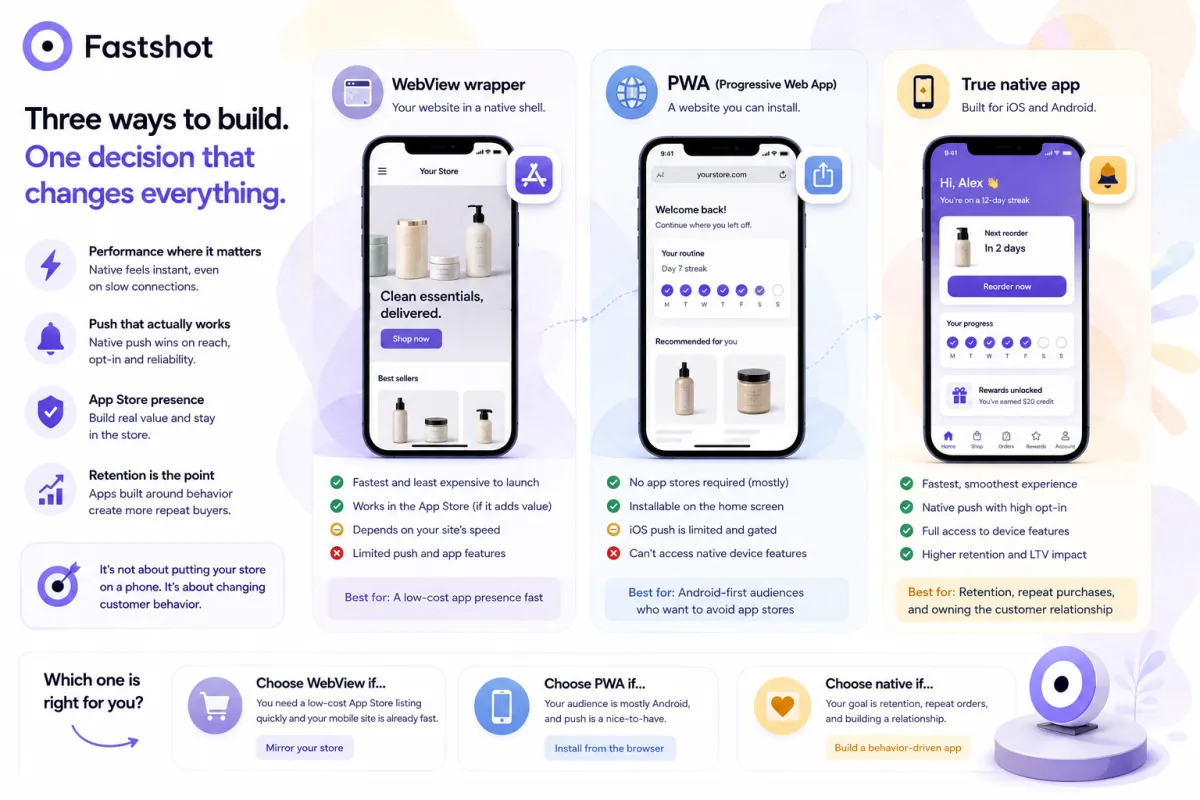
When a Shopify merchant decides to "build an app," they're usually picturing one thing: their store, on a phone, with an icon on the home screen. But under that single mental image sit three completely different technologies — a WebView wrapper, a PWA, and a true native app — and the one you pick quietly decides almost everything that matters afterward. How fast it feels. Whether push notifications actually work. Whether Apple even lets it into the App Store. And whether it becomes a retention engine or just a glossier bookmark.
The category doesn't make this easy. Most builders blur the lines on purpose, because "native" sounds better in a sales deck than "we wrapped your mobile site." So here's the plain-English version: what each approach actually is, where each one breaks, and how to match the technology to your goal. If you just want a cheap App Store listing, a wrapper is fine. If you want an app that changes how customers behave — that's a different machine entirely.
The three approaches, in plain English
Strip away the marketing and there are exactly three ways to get your Shopify store onto a phone:
- WebView wrapper — your existing mobile website, loaded inside a thin native shell. The "app" is essentially a browser with no address bar. Cheap, fast to ship, and entirely dependent on the site it's wrapping.
- PWA (Progressive Web App) — a website built to be installable, running from the browser engine but able to live on the home screen and work partly offline. No app store required (mostly), but the platform — especially Apple — controls what it's allowed to do.
- True native app — a real iOS/Android application built with native components (or a native framework like React Native), talking directly to your Shopify catalog through an API. It owns the full device: gestures, push, biometrics, the works.
They look similar on the home screen. They are not similar where it counts.
Performance: where the gap shows up — and where it doesn't
Be honest about this one, because the category lies in both directions. For plain catalog browsing on a modern phone, the performance gap between a well-built WebView app and native has genuinely narrowed — users often can't tell the difference scrolling a product grid. Anyone claiming a wrapper is unusably slow is overselling.
But the gap reappears exactly where it hurts:
- A wrapper inherits your site's speed. If your Shopify theme has mediocre Core Web Vitals, the app is just as sluggish — wrapping a slow site doesn't make it fast. Native apps cache locally and render with the OS, so they feel instant even on flaky connections.
- Interactions, not just page loads. Transitions, gesture-driven navigation, sticky carts, and animations are where native pulls ahead and webviews start to feel like a website pretending to be an app.
- PWAs ride the browser engine. On iOS that means WebKit, full stop, with whatever constraints Apple imposes that quarter.
The practical read: a wrapper is "fine" for browsing; native is where the experience feels owned. See our deeper mobile app vs. mobile website breakdown for why that owned feeling drives conversion.
Push notifications: the dimension that actually decides it
If retention is the point, push is the whole ballgame — and this is where PWAs fall apart on iOS.
Apple only added web push to iOS at all in 2023 (iOS 16.4), and the constraints are still severe in 2026:
- The user must "Add to Home Screen" first. Web push on iOS only works for installed PWAs — an open Safari tab gets nothing. That single requirement collapses your reachable audience to the tiny fraction of visitors who manually install.
- No silent permission, lower opt-in. iOS requires an explicit tap to even show the permission prompt, and PWA opt-in rates run a fraction of native. Developers regularly report web push that works, then silently stops.
- Native (and properly built wrappers) use the real push infrastructure. That's lock-screen delivery, rich notifications, and an owned channel with no per-message cost — typically far higher opt-in than web push.
WebView wrappers, notably, can tap native push because they ship a real native shell. PWAs structurally cannot match it on iOS. If your retention plan depends on reaching customers after they leave — and it should — PWA push is a trap on the platform half your customers use.
App-store presence: who gets in, and who gets bounced
An App Store listing isn't just distribution — it's credibility and a discovery surface. The approval rules cut hard across the three:
- Native sails through. There's no ambiguity; it's a real app.
- WebView wrappers live under Apple's Guideline 4.2, which demands an app "elevate beyond a repackaged website." A bare wrapper with no native navigation, push, or added value gets rejected — but a well-engineered one with real app-like features gets approved routinely.
- PWAs generally aren't in the App Store at all by design — they install from the browser. You can wrap a PWA to submit it, at which point you're back to the 4.2 problem.
The lesson: the store rewards genuine app behavior. The thinner the layer over your website, the more rejection risk you carry.
Cost and time to launch: the wrapper's real advantage
This is where wrappers and PWAs earn their place. Built from scratch, a custom native app runs roughly $50K–$150K per platform plus 10–20% a year in maintenance, and six-plus months to a first version. A WebView wrapper or PWA reuses your existing site and can ship in weeks at a fraction of the cost.
But that framing is outdated for most merchants. No-code and AI-driven builders have collapsed native economics — you no longer choose between "cheap wrapper" and "six-figure native." You can get a genuinely native app for a flat monthly fee in days. For a full breakdown, see our guide to Shopify mobile app cost. The old trade-off — pay more for native, or settle for a wrapper — mostly no longer exists.
Retention implications: a bookmark vs. an engine
Here's the part the technical comparison usually misses. A WebView wrapper and a PWA, at best, give customers a faster way to revisit your store. That's a better bookmark. It doesn't change behavior.
A native app can be built around a behavior loop — usage tracking, progress and streaks, routines mapped to how the product is actually used, and reorder triggers timed to real depletion, all delivered through native push. That's the difference between an app customers open when they happen to think of you and one that brings them back on its own. With ~70% of customers gone after the first order, the second machine is the only one that moves lifetime value.
A wrapper can't host that loop, because it's just your website. A PWA can't reliably reach customers on iOS, because push is gated. Native is the only approach with the surface and the channel to actually drive retention.
How to choose
Match the technology to the job:
- Pick a WebView wrapper if you want a low-cost App Store presence fast, your mobile site is already quick, and you don't need an app to do more than mirror it.
- Pick a PWA if your audience skews Android, you want to skip the app stores, and push is a nice-to-have rather than your retention strategy.
- Pick true native if the app's job is retention — repeat purchases, an owned push channel, and an experience built around how customers use the product. That's the only configuration where the app pays for itself.
Fastshot builds native, on purpose — because behavior-driven retention needs native push and a real app surface, neither of which a wrapper or PWA delivers in full. If you're still mapping options, our guide on how to choose a Shopify mobile app platform walks through the buyer questions, and our piece on turning your Shopify store into a mobile app covers whether to build at all.
Drop your Shopify URL into Fastshot and see a free working app preview — built natively around your store — in 48 hours. No card.
Frequently asked questions
Is a WebView app the same as a native app? No. A WebView app loads your website inside a native shell, so it inherits your site's speed and limits. A true native app is built with native components and talks to Shopify via API — it feels faster, handles gestures and push more reliably, and isn't tied to your site's performance.
Can a PWA send push notifications on iPhone? Only in a limited way. Since iOS 16.4, web push works on iOS — but only after the user manually adds the PWA to their home screen, and opt-in rates run far below native. For retention that depends on push, native (or a wrapper using native push infrastructure) is the dependable choice.
Which is cheapest — WebView, PWA, or native? Historically wrappers and PWAs were far cheaper than custom native builds that ran into six figures. But modern no-code and AI builders now ship genuinely native apps for a flat monthly fee in days, so the cost gap that once justified settling for a wrapper has largely closed.
See your app before you commit
Drop your Shopify store URL into Fastshot and get a free working app preview — built around your retention loop — in 48 hours. No card, no engineering.
Get my free preview →