
Shopify BFCM Mobile App Marketing Guide (2026)
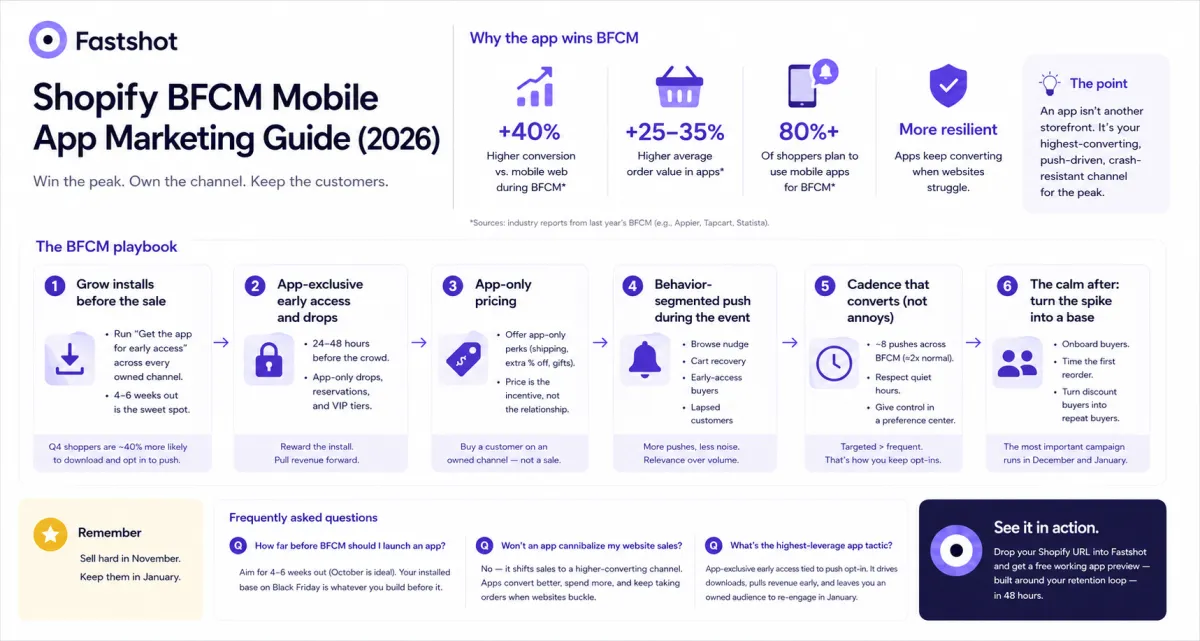
Black Friday and Cyber Monday is the one weekend of the year where your worst infrastructure problems and your best growth opportunities show up at the same time. Mobile already drives the majority of online sales during the peak — somewhere north of half — but mobile web converts at roughly half the rate of desktop, stalling around 3% while carts time out and pages buckle under traffic. That gap is where margin quietly leaks out of your BFCM.
A mobile app closes most of it. Apps convert meaningfully higher than mobile web during the peak — analyses of last year's BFCM put the lift around 40% on average and far higher for the best operators — with bigger baskets, faster checkout, and a push channel you actually own when email deliverability gets ugly on the busiest weekend of the year. Shoppers are leaning in, too: the share planning to shop via mobile apps during BFCM has climbed past 80%, while desktop browsing keeps sliding.
This guide is the playbook for using an app to win BFCM 2026 — not as a second storefront, but as your highest-converting, push-driven, crash-resistant channel for the peak. We'll cover growing the install base before the sale, app-exclusive early access and drops, app-only pricing, behavior-segmented push during the event, and the part almost everyone fumbles: the calm after, when the spike either becomes a customer base or evaporates.
Why the app is your peak-weekend channel
The case for an app at BFCM is not branding. It's mechanics.
- Conversion — apps out-convert mobile web during the peak because logged-in users skip re-authentication, stored payment makes checkout one tap, and the experience doesn't fall over under load.
- Owned reach — push hits the home screen directly. When everyone's email is buried in a Black Friday avalanche and SMS costs spike, push still lands. (More on why in push notifications vs email and SMS.)
- Resilience — your app talks to its own backend, not your storefront theme. When traffic surges, app users keep checking out while the website struggles.
- Bigger baskets — app shoppers tend to spend more per order, with reported AOV lifts in the 25–35% range, because returning, logged-in buyers browse with more intent.
None of that matters if nobody has the app installed. Which is the whole point of starting early.
Grow the install base before the sale
You cannot acquire an app audience on Black Friday morning. The base you sell to in late November is the base you build in October. The good news: Q4 is the easiest time of year to get installs — shoppers are roughly 40% more likely to download an app and opt into push during the holiday run-up, because the incentive is obvious.
So give them the obvious incentive. The strongest pre-BFCM hook is access, not a discount: "Get the app to unlock our Black Friday sale a day early." Run it across every owned surface — email, SMS, your site's mobile header, packing inserts, your post-purchase page — for the four to six weeks before the event. Treat it as a campaign with a number attached, because the size of your installed base is the ceiling on everything that follows. We go deeper on the tactics in how to get mobile app downloads.
The second job of the pre-sale window is getting push opt-in. Don't ask for it on first launch with no context. Ask after someone has done something — added to a wishlist, set a drop reminder — and frame the value plainly: "Turn on alerts so you don't miss early access." App push opt-in rates run high when the ask is timed and relevant — often two-thirds or more of users.
App-exclusive early access and drops
Once the base exists, early access is the lever that makes the app feel worth keeping. Open your BFCM deals to app users 24–48 hours before everyone else. This does two things at once: it rewards the install (so opt-ins stick), and it pulls a chunk of revenue forward into a lower-traffic window where checkout is smooth and your fulfillment isn't yet underwater.
Pair early access with genuinely app-only moments:
- Limited drops — a bundle, a doorbuster, or a capsule SKU that only exists in the app and only for app users.
- Reserve-in-app — let users lock a deal or reserve inventory from a push, so the urgency lives on the home screen instead of in an inbox.
- VIP tiers — your repeat buyers get the earliest access of all, which both protects margin and reinforces the loyalty you're trying to build.
The principle: the app should never be the same sale shown in a smaller window. It should have something the website literally does not.
App-only pricing — used carefully
App-exclusive discounts work, but treat the discount as the acquisition cost for a channel, not as the relationship. A modest app-only price (free shipping, an extra few percent, a gift with purchase) is a clean reason to install and buy in-app. What you're buying is a customer on an owned channel with push enabled — not a sale you'd have made anyway.
The trap is training your audience to wait for the next app discount. Lead with access and exclusivity; let price be the tiebreaker, not the entire pitch. If the only reason anyone opens your app is a coupon, you've built a coupon, not an app.
Behavior-segmented push during the event
During the peak, push frequency goes up — brands roughly double their cadence over the event window, sending on the order of eight pushes across the core days. That's fine if the messages are segmented by behavior. It's a fast way to get uninstalled if they're all the same blast.
Segment by what people actually did:
- Browsed, didn't buy — nudge the specific category or product they viewed, not a generic "sale ends soon."
- Cart abandoners — cart-recovery push is shockingly underused at BFCM (most brands skip it) even though it drives an outsized share of app revenue. Wire it up.
- Early-access buyers — don't re-pitch the sale they already took. Cross-sell or thank them.
- Lapsed customers — a "your size is back / early access for you" beats a flat discount.
Cadence is the line between owned and annoying. Most users tolerate a few well-targeted pushes a day during a known sale event; unsubscribes climb sharply once messages become frequent and irrelevant. Build a preference center, respect quiet hours, and let relevance — not volume — carry the weekend. We cover the cadence question in detail in do push notifications annoy customers and the broader system in our Shopify push notification strategy.
The part everyone misses: the calm after
Here's the uncomfortable truth about a great BFCM. You just acquired a flood of customers at your deepest discount of the year, on your least loyal demand. Most of them will never buy again. New-customer repeat rates hover in the low twenties, and a large share of first-time BFCM buyers go fully dormant within weeks. The spike is not a win until it becomes a base.
So the most important push campaign of the season isn't on Black Friday — it's the one that runs in December and January. The app is the only channel positioned to do that work, because it's where the customer already is and where you can guide them into actually using what they bought. That post-BFCM motion — onboarding, first-reorder timing, turning discount buyers into repeat buyers — is a whole discipline of its own, and it's where the real money is. We laid it out in BFCM retention strategies.
The app you build for the peak and the app you build for retention are the same app. Sell hard in November; keep them in January.
Drop your Shopify URL into Fastshot and see a free working app preview — built around the retention loop your category needs — in 48 hours.
Frequently asked questions
How far before BFCM should I launch a mobile app? Aim to have the app live and your install campaign running four to six weeks out — ideally October for a late-November BFCM. Q4 is when shoppers are most willing to download and opt into push, and your installed base on Black Friday is whatever you built before it, so the earlier the base exists, the more revenue early access and push can drive.
Won't an app cannibalize my website sales during BFCM? No — it shifts them to a higher-converting, more resilient channel. App buyers tend to convert better and spend more, and the app keeps taking orders when website traffic surges and checkout strains. You're not splitting one sale in two; you're moving demand to where it closes more reliably and where you can re-engage the buyer afterward.
What's the single highest-leverage app tactic for BFCM? App-exclusive early access tied to push opt-in. It rewards the install, drives opt-in rates up, and pulls revenue into a calmer pre-peak window with smooth checkout — and it leaves you with an owned audience you can re-engage in January, which is where most BFCM revenue is otherwise lost.
See your app before you commit
Drop your Shopify store URL into Fastshot and get a free working app preview — built around your retention loop — in 48 hours. No card, no engineering.
Get my free preview →