
How to Increase Average Order Value (AOV) on Shopify in 2026
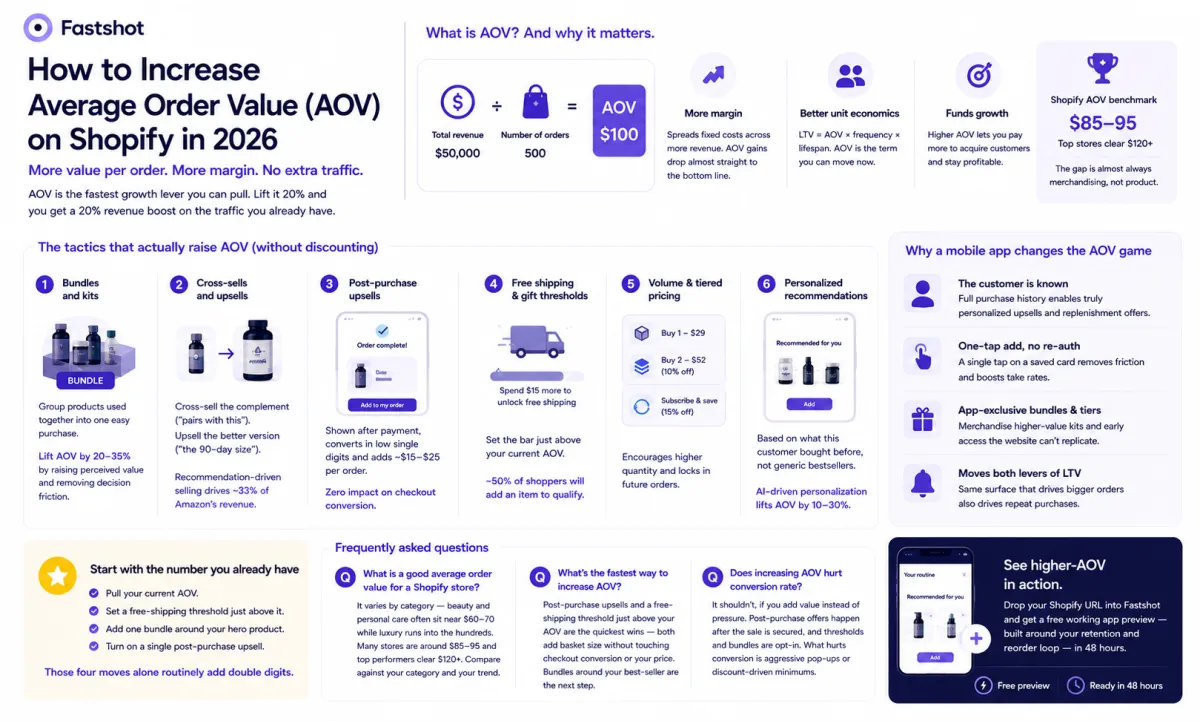
Most growth advice starts with the same instinct: get more traffic. More ads, more channels, more spend. But there's a faster, cheaper lever sitting inside every order you already win — how much each customer spends when they check out.
Average order value (AOV) is the one growth metric you can move without paying for a single extra visitor. Lift it 20% and you've handed yourself a 20% revenue bump on the traffic you already have — no rise in acquisition cost, no new channel to learn. For most Shopify brands, it's the most under-worked number on the dashboard.
This article covers what AOV is, why it's the fastest lifetime-value lever to move, the tactics that actually raise it without training customers to wait for discounts, and where a mobile app fits.
What average order value is — and why it punches above its weight
AOV is simply total revenue divided by number of orders. Do $50,000 across 500 orders and your AOV is $100.
It matters more than it looks because it compounds with everything else:
- It's pure margin leverage. A bigger basket spreads your fixed costs — shipping, payment fees, picking and packing, the ad you already paid for — across more revenue. AOV gains often drop almost straight to the bottom line.
- It improves unit economics today. Lifetime value is
AOV × purchase frequency × customer lifespan. AOV is the term you can move now, without waiting for a second or third order to land. (More in our LTV breakdown.) - It funds acquisition. A higher AOV lets you afford a higher cost per order and stay profitable — useful when ad auctions keep getting more expensive.
For context, Shopify-platform AOV tends to sit around $85–$95, with the strongest stores clearing $120+. That gap is almost never product — it's merchandising.
Don't confuse a bigger cart with a discounted one
Before the tactics, the trap: the lazy way to raise AOV is to bribe it. "Spend $100, get 20% off." It works once, then it teaches customers that the real price is the discounted one — and your margin, the entire reason AOV matters, evaporates.
Every tactic below adds value or convenience to the order, not a price cut. You want customers buying more because it makes sense for them, not because you blinked first.
The tactics that actually raise AOV
- Bundles and kits. Group products used together into one easy purchase. Bundles routinely lift AOV by 20–35% because they raise perceived value and remove decision friction — the customer buys the outcome, not five separate SKUs. (Full playbook: bundles, kits & cross-sells.)
- Cross-sells and upsells. Cross-sell the complement ("pairs with this"); upsell the better version ("the 90-day size saves you 15%"). Done well, recommendation-driven selling drives a serious share of revenue — Amazon famously attributes roughly a third of its revenue to it.
- Post-purchase upsells. The highest-leverage, lowest-risk move in commerce. An offer shown after the customer has paid converts in the low single digits and adds roughly $15–$25 per order — with zero effect on checkout conversion, because the original sale is already banked.
- Free-shipping and gift thresholds. Set the bar just above your current AOV. Around half of shoppers will add an item to qualify — you trade shipping you'd often eat anyway for a bigger basket.
- Volume and tiered pricing. "Buy 2, save 10%" or subscribe-and-save on consumables nudges quantity up while locking in future orders.
- Personalized recommendations. Generic "you may also like" is wallpaper. Recommendations based on what this customer bought before convert far better — AI-driven personalization is reported to lift AOV by 10–30%.
Where a mobile app changes the AOV math
Most of those tactics live on your website, where the shopper is anonymous, logged out, and one tab away from leaving. A mobile app changes the surface they run on:
- The customer is known. A logged-in app sees full purchase history, so "complete your routine" and replenishment upsells are genuinely personalized — not guesses.
- One-tap add, no re-auth. Friction kills upsells. When adding the recommended item is a single tap on a saved card, take rates climb.
- App-exclusive bundles and tiers. The app becomes the place to merchandise higher-value kits and early access — a reason to spend more the website can't replicate.
That's the same surface that drives repeat purchases, which is why an app moves both halves of LTV — bigger orders and more of them. (Here's how the two levers compare.)
Start with the number you already have
You don't need more traffic to grow this quarter. Pull your current AOV, set a free-shipping threshold just above it, add one bundle around your hero product, and turn on a single post-purchase upsell. Those four moves alone routinely add double digits — on customers you're already paying to acquire.
Curious what a higher-AOV experience would look like for your store? Drop your Shopify URL into Fastshot and see a free working app preview — built around your retention and reorder loop — in 48 hours.
Frequently asked questions
What is a good average order value for a Shopify store? It varies hugely by category — beauty and personal care often sit near $60–70 while luxury runs into the hundreds. On Shopify, many stores land around $85–95 and top performers clear $120+. Compare against your own category and your own trend, not a global average.
What's the fastest way to increase AOV? Post-purchase upsells and a free-shipping threshold set just above your current AOV are the quickest wins — both add basket size without touching checkout conversion or your price. Bundles around your best-seller are the next step.
Does increasing AOV hurt conversion rate? It shouldn't, if you add value instead of pressure. Post-purchase offers happen after the sale is secured, and thresholds and bundles are opt-in. What hurts conversion is aggressive pop-ups or discount-driven minimums that make shoppers feel manipulated.
See your app before you commit
Drop your Shopify store URL into Fastshot and get a free working app preview — built around your retention loop — in 48 hours. No card, no engineering.
Get my free preview →