
Bundles, Kits & Cross-Sells: How to Raise AOV Without Discounting
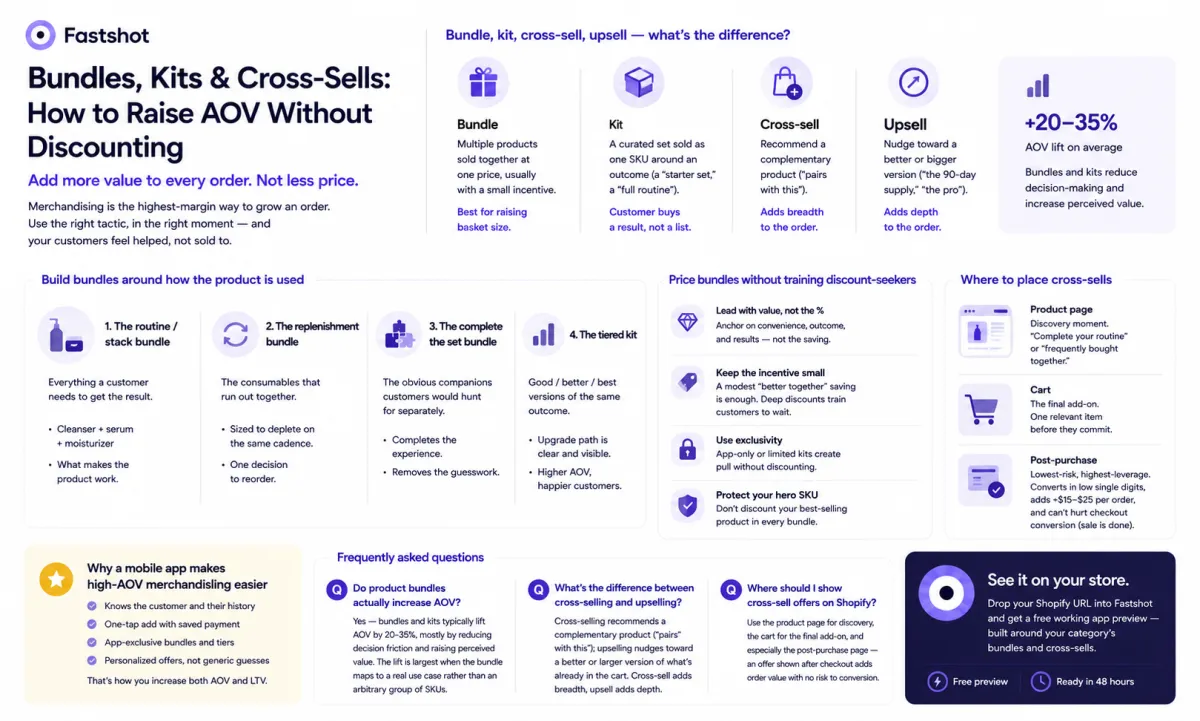
Ask ten Shopify merchants how they'll raise average order value and most will say "bundles." Ask what a bundle actually is — versus a kit, a cross-sell, or an upsell — and the answers get fuzzy. That fuzziness is why so many bundling efforts quietly underperform.
Merchandising is the highest-margin way to grow an order, because it adds value instead of cutting price. But it only works when you pick the right mechanic for the right moment. This article defines the four moves, shows how to build them around how your product is actually used, and explains how to price them without training customers to wait for a deal.
Bundle, kit, cross-sell, upsell — what's the difference
They're not interchangeable. Each solves a different problem:
- Bundle — multiple products sold together at a single price, usually with a small "better together" incentive. Best for raising basket size on related items.
- Kit — a curated set sold as one SKU around an outcome (a "starter set," a "full routine"). The customer buys a result, not a list.
- Cross-sell — recommending a complementary product ("pairs with this"). Adds breadth to the order.
- Upsell — nudging toward a better or bigger version of what they're already buying ("the 90-day supply," "the pro model"). Adds depth.
Bundles and kits raise AOV by 20–35% on average, largely because they cut decision-making: one confident choice beats five uncertain ones.
Build bundles around how the product is used, not what's in stock
The bundles that work aren't a random "save 10% on these three." They mirror a real use case:
- The routine / stack bundle. Everything a customer needs to actually get the result — the cleanser, serum, and moisturizer, not three SKUs you'd like to move. This ties directly to usage, which is what makes a product stick and get reordered.
- The replenishment bundle. The consumables that run out together, sized to deplete on the same cadence so the reorder is one decision.
- The "complete the set" bundle. The obvious companions a customer would otherwise hunt for separately.
- The tiered kit. Good / better / best versions of the same outcome, so the upgrade is visible and easy to choose.
When the bundle maps to how the product is used, it stops feeling like a sales tactic and starts feeling like help.
Price bundles without training discount-seekers
The fastest way to wreck your margin is to make every bundle a discount. Lead with value instead:
- Anchor on convenience and outcome, not the percentage saved. "The full routine, in one tap" beats "Save 15%."
- Keep the incentive small. A modest "better together" saving is enough; a deep one just teaches customers to wait and buy the bundle instead of the item at full price.
- Use exclusivity instead of money. An app-only or limited kit creates pull without discounting.
- Protect your hero SKU. Don't default to discounting the product that already sells well into every bundle.
Where to place cross-sells — placement is half the battle
The same offer wins or loses on where it appears:
- Product page — "frequently bought together" / "complete your routine." Catches intent while the customer is researching.
- Cart — the classic add-on moment: one more relevant item before they commit.
- Post-purchase — the most underused, lowest-risk slot. Offered after payment, it converts in the low single digits, adds ~$15–25 per order, and can't hurt checkout conversion because the sale is already done.
A good rule: one well-targeted suggestion per moment beats a wall of "you may also like."
Why a mobile app makes high-AOV merchandising easier
On the web, every cross-sell is a guess at an anonymous shopper. In a logged-in app, it's personalized:
- It knows the history, so "complete your routine" is built from what the customer actually owns.
- One-tap add on a saved card removes the friction that kills add-ons.
- App-exclusive bundles and tiers give you a place to merchandise higher-value sets you don't surface anywhere else.
That's the execution layer behind the numbers — covered in the in-app upsell playbook, and part of the broader AOV game plan.
The takeaway
Bundling isn't a discount strategy — it's a clarity strategy. Group products around how customers use them, lead with the outcome rather than the saving, and put the right offer in the right moment. That's how you grow the basket and keep the margin.
Want to see app-exclusive, personalized bundles running on your catalog? Drop your Shopify URL into Fastshot and get a free working app preview in 48 hours.
Frequently asked questions
Do product bundles actually increase AOV? Yes — bundles and kits typically lift average order value by 20–35%, mostly by reducing decision friction and raising perceived value. The lift is largest when the bundle maps to a real use case rather than an arbitrary group of SKUs.
What's the difference between cross-selling and upselling? Cross-selling recommends a complementary product ("pairs with this"); upselling nudges toward a better or larger version of what's already in the cart ("the 90-day size"). Cross-sell adds breadth to the order, upsell adds depth.
Where should I show cross-sell offers on Shopify? Use the product page for discovery, the cart for the final add-on, and especially the post-purchase page — an offer shown after checkout adds order value with no risk to conversion, because the original purchase is already complete.
See your app before you commit
Drop your Shopify store URL into Fastshot and get a free working app preview — built around your retention loop — in 48 hours. No card, no engineering.
Get my free preview →