
Upsells & Personalized Recommendations in a Mobile App: An AOV Playbook
A "you may also like" carousel on your website is selling blind. It doesn't know who the shopper is, what they bought last month, or whether they're a first-timer or your best customer. It shows everyone roughly the same thing and hopes.
A logged-in mobile app sells with its eyes open. It knows the customer, their history, and their habits — which is exactly what upsells and recommendations need to actually work. That difference is why in-app is one of the most effective places to lift average order value. This is the execution playbook: why the app surface wins, the tactics that move AOV, and how to measure them.
Why the app is a better upsell surface than the web
The mechanics that make upsells convert are all stronger in an app:
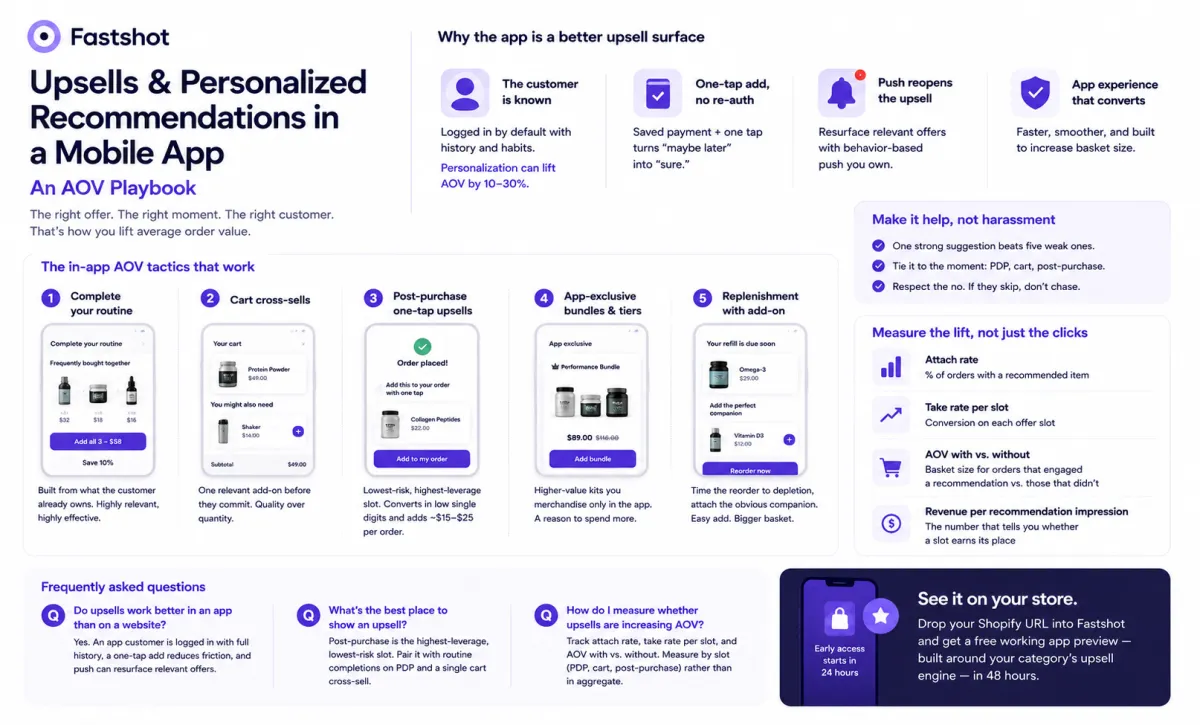
- The customer is known. Logged in by default, with full order history — so a recommendation is personalized, not a guess. AI-driven personalization is reported to lift AOV by 10–30%, and personalization needs identity to work.
- One-tap add, no re-auth. Friction is what kills add-ons. A saved payment method and a single tap turn "maybe later" into "sure."
- Push reopens the upsell. The web can only sell when the customer happens to visit. An app can resurface a relevant add-on or replenishment offer with a behavior-based push — an upsell channel the web simply doesn't have.
The in-app AOV tactics that work
- "Complete your routine" on the product page. Built from what the customer already owns, not a generic pairing. The strongest version of cross-sell because it's genuinely useful.
- Cart cross-sells. One relevant add-on before they commit — quality over a wall of suggestions.
- Post-purchase one-tap upsells. The lowest-risk slot in commerce: shown after payment, it converts in the low single digits and adds roughly $15–25 per order with zero impact on your checkout conversion rate.
- App-exclusive bundles and tiers. Higher-value kits you merchandise only in the app — a reason to spend more that also rewards the install. (The bundling playbook.)
- Replenishment-with-add-on. When you nudge a reorder timed to depletion, attach the obvious companion — the customer's already buying, so the add-on is easy.
- AI personalized recommendations. Let purchase history and behavior drive what's shown, instead of best-seller lists everyone sees. (More on the AI tools for this.)
Make it help, not harassment
The line between an upsell that lifts AOV and one that tanks trust is relevance:
- One strong suggestion beats five weak ones. Carousels of everything read as noise.
- Tie it to the moment. A routine completion at the PDP, a companion at the cart, a relevant upgrade after purchase — not the same offer everywhere.
- Respect the no. If they skip the post-purchase offer, don't chase it. The goal is order value and a relationship that survives.
Measure the lift, not just the clicks
If you can't measure it, you can't improve it. Track:
- Attach rate — share of orders that include a recommended item.
- Take rate per slot — conversion on each offer slot (PDP vs cart vs post-purchase).
- AOV with vs without — basket size for orders that engaged a recommendation against those that didn't.
- Revenue per recommendation impression — the number that tells you whether a slot earns its place.
Watch them by slot, not in aggregate — post-purchase and PDP behave very differently, and you'll want to double down on whichever earns most for your catalog. The same logged-in surface also drives reorders, so you're growing both halves of LTV at once.
The point
Upsells don't fail because customers won't spend more — they fail when the offer is generic, mistimed, or a hassle to accept. A logged-in app fixes all three: it knows the customer, it can place the offer in the right moment, and it makes saying yes a single tap. That's how you raise the basket without raising the pressure.
Want to see personalized, app-exclusive upsells running on your own catalog? Drop your Shopify URL into Fastshot and get a free working app preview in 48 hours.
Frequently asked questions
Do upsells work better in an app than on a website? Generally yes. An app customer is logged in with full purchase history, so recommendations are personalized rather than generic, and a one-tap add on a saved card removes the friction that kills web add-ons. Apps can also resurface upsells via push, which the web can't.
What's the best place to show an upsell? Post-purchase is the highest-leverage, lowest-risk slot — shown after payment, so it adds order value without affecting checkout conversion. Pair it with "complete your routine" on the product page and a single relevant cart cross-sell.
How do I measure whether upsells are increasing AOV? Track attach rate, take rate per offer slot, and AOV for orders that engaged a recommendation versus those that didn't. Measure by slot (PDP, cart, post-purchase) rather than in aggregate, since they perform very differently.
See your app before you commit
Drop your Shopify store URL into Fastshot and get a free working app preview — built around your retention loop — in 48 hours. No card, no engineering.
Get my free preview →