
AOV vs Retention: The Two Levers That Actually Grow LTV
Every brand asks the same question when growth gets expensive: where do we find more revenue without buying more traffic? Two answers come back — sell each customer a bigger order, or sell them more often, for longer. Average order value versus retention.
It's usually framed as a choice. It isn't. They're two terms in the same equation, and the smartest brands work both. But they're won in completely different ways, and knowing which to prioritize first can save you a quarter of wasted effort.
This article breaks down the lifetime-value equation, shows why AOV and retention are complementary rather than competing, and gives you a simple way to decide which lever to pull first.
The equation both levers live in
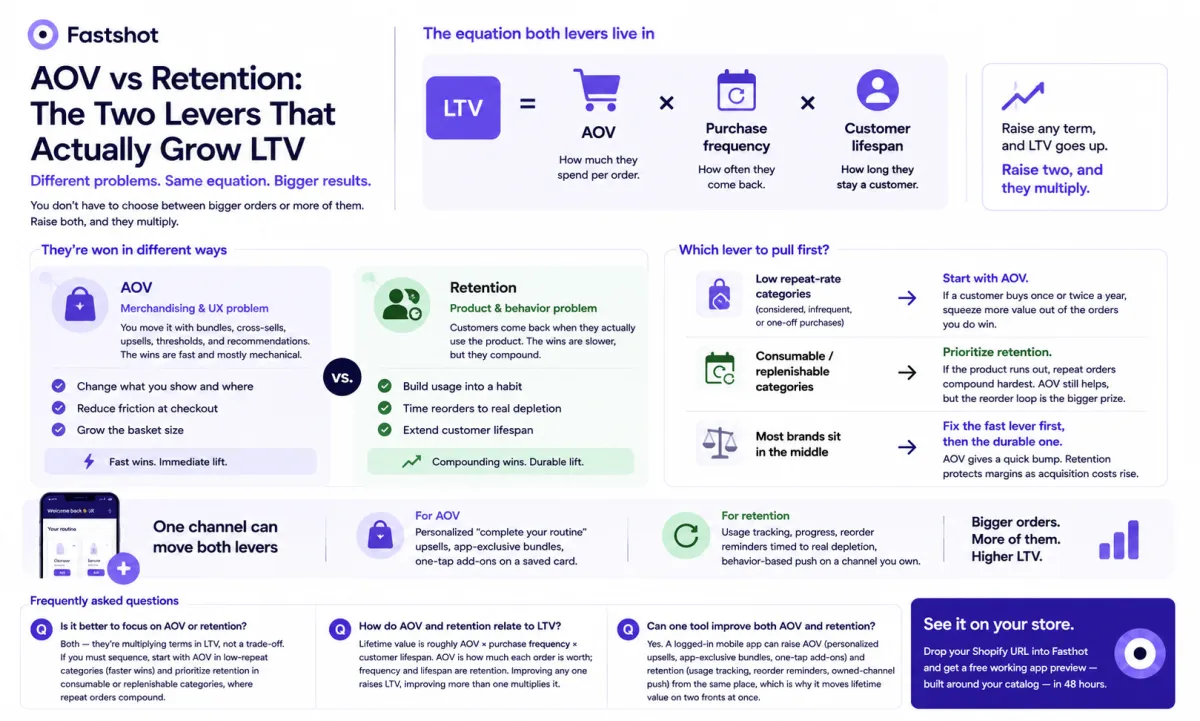
Customer lifetime value has three controllable parts:
LTV = AOV × purchase frequency × customer lifespan
- AOV is how much they spend per order.
- Frequency × lifespan is retention — how often they come back, and for how long.
Raise any term and LTV goes up. Raise two and they multiply. That's why the AOV-or-retention debate is a false choice: they don't trade off, they compound.
They're won in different ways
Here's the part most advice skips — the two levers are different kinds of problem:
- AOV is a merchandising and UX problem. You move it with bundles, cross-sells, upsells, thresholds, and recommendations. The wins are fast and mostly mechanical — change what you show and where, and the basket grows. (The AOV playbook.)
- Retention is a product and behavior problem. You can't email your way to it. Customers come back when they actually use the product — when it becomes a habit and the reorder is automatic. The wins are slower, but they compound. (Why retention is a product problem.)
Treating them the same is the mistake. Discount codes don't build a habit; a loyalty program doesn't fix a cart that's too small.
Which lever to pull first
Both matter, but sequencing depends on your category:
- Low repeat-rate categories (considered, infrequent, or one-off purchases) → start with AOV. If a customer realistically buys once or twice a year, squeezing out more reorders is hard. Make the orders you do win bigger with bundles and upsells.
- Consumable / replenishable categories → retention compounds harder. If the product runs out, the second, fifth, and tenth orders are where the money is. AOV still helps, but the reorder loop is the bigger prize.
- Most brands sit in the middle → fix the fast lever first, then the durable one. AOV gives you a quick bump on existing traffic; retention is the longer build that protects you from rising acquisition costs and retention plateaus.
A quick gut check: if your repeat-purchase rate is decent but baskets are small, lead with AOV. If orders are healthy but nobody comes back, retention is your ceiling.
Why one channel can move both
Here's the leverage: you don't need separate tools for each. A logged-in mobile app moves both levers from the same surface.
- For AOV: personalized "complete your routine" upsells, app-exclusive bundles, one-tap add-ons on a saved card.
- For retention: usage tracking, progress, reorder reminders timed to real depletion, and behavior-based push on a channel you own.
The same app that gets a customer to add one more item also gets them to come back next month. That's why building the channel pays off twice — bigger orders and more of them.
Don't pick — sequence
AOV and retention aren't rivals; they're multipliers in the same LTV equation. AOV is the fast, mechanical lever you can move this quarter. Retention is the durable, compounding one that protects your margins as ads get pricier. Start with whichever your category rewards first — then build the other, ideally on one channel that drives both.
Want to see an app that lifts both your basket size and your repeat rate? Drop your Shopify URL into Fastshot and get a free working app preview in 48 hours.
Frequently asked questions
Is it better to focus on AOV or retention? Both — they're multiplying terms in LTV, not a trade-off. If you must sequence, start with AOV in low-repeat categories (faster wins) and prioritize retention in consumable or replenishable categories, where repeat orders compound.
How do AOV and retention relate to LTV? Lifetime value is roughly AOV × purchase frequency × customer lifespan. AOV is how much each order is worth; frequency and lifespan are retention. Improving any one raises LTV; improving more than one multiplies it.
Can one tool improve both AOV and retention? Yes. A logged-in mobile app can raise AOV (personalized upsells, app-exclusive bundles, one-tap add-ons) and retention (usage tracking, reorder reminders, owned-channel push) from the same place, which is why it moves lifetime value on two fronts at once.
See your app before you commit
Drop your Shopify store URL into Fastshot and get a free working app preview — built around your retention loop — in 48 hours. No card, no engineering.
Get my free preview →