
The Best AI Tools for Ecommerce Brands in 2026
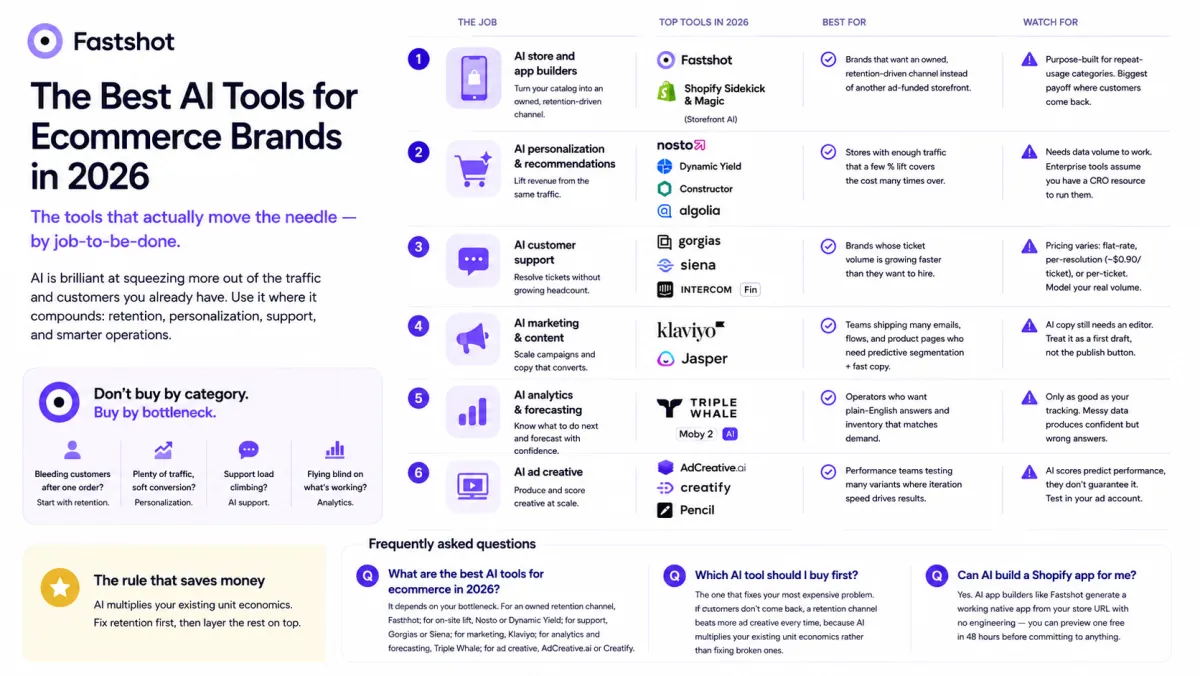
Every "best AI tools" list reads like the same alphabet soup: forty logos, no point of view, and no sense of which problem each one actually solves. That's useless when you're an operator. The question isn't "what AI tools exist" — it's "which tool earns its monthly fee against a specific job I'm trying to get done."
So this guide is organized by job-to-be-done, not by hype. For each category we name the real, current tools worth your attention in 2026, who they fit, and what to watch before you commit. The goal is a buyer's map you can actually act on — pick the category that matches your bottleneck, then pick the tool inside it.
One framing note before the list. AI is brilliant at squeezing more out of the traffic and customers you already have. It's terrible at fixing a business that loses every customer after one order. So we've put the tools that affect lifetime value — app builders, personalization, support — first, because that's where the compounding money is.
1. AI store and app builders — turn your catalog into an owned channel
This category builds the surface customers actually shop on. Shopify's own Sidekick and Magic suite now generate product copy, theme tweaks, and store sections from prompts, which is the fastest way to clean up a storefront. But a web storefront is a renting channel — you pay for every visit through ads. An owned channel is different.
Fastshot sits here as the retention-native option. You enter your Shopify store URL and its AI generates a working native mobile app from your catalog — no engineering, free preview in 48 hours. The difference from a generic app wrapper is the loop it builds in: a routine or protocol builder mapped to your category, usage tracking with progress and streaks, reorder triggers timed to real depletion, and behavior-based push instead of blasts. It's built around the thesis that retention is a product problem — Usage leads to Habit leads to Reorder — not a marketing afterthought. See how that compares to other AI Shopify app builders if you're weighing the category.
Best for: brands that want an owned, retention-driven channel rather than another ad-funded storefront. Watch for: it's purpose-built for repeat-usage categories, so the payoff is largest where customers come back (which is most stores).
2. AI personalization and recommendations — lift revenue from the same traffic
Product recommendations can account for up to roughly a third of ecommerce revenue when shoppers engage with them, which makes this the highest-leverage on-site AI category. The leaders cluster by scale.
- Nosto runs end-to-end personalization across recommendations, search, merchandising, and content, and now ships an always-on AI agent (Huginn) that surfaces revenue opportunities. Strong fit for mid-market DTC.
- Dynamic Yield and Monetate are the enterprise experimentation engines — deepest A/B testing, most credible at scale.
- Constructor and Algolia own AI-powered search and discovery, ranking results by commercial outcome rather than keyword match.
Best for: stores with enough traffic that a few percentage points of conversion lift covers the cost many times over. Watch for: personalization needs data volume to work — thin catalogs and low traffic see weaker gains, and enterprise tools assume you have a CRO resource to run them.
3. AI customer support — resolve tickets without growing headcount
Support automation has matured from canned-reply bots into agents that resolve full tickets. The Shopify-native pick is Gorgias, with the deepest store integration and an AI agent that attributes recovered revenue — though its AI automation is Shopify-only. Siena is the AI-native DTC option, running across email, chat, WhatsApp, and social with a reasoning engine that processes returns and tracks orders end-to-end. Intercom Fin is messenger-first with resolution-based pricing, strong if in-app chat is your primary channel.
Best for: brands whose ticket volume is growing faster than they want to hire. Watch for: pricing models diverge sharply — flat-rate, per-resolution (around $0.90/ticket), and per-ticket all exist. Model your real ticket volume before signing, because the cheapest headline price isn't always the cheapest bill.
4. AI marketing and content — scale campaigns and copy
This is the most crowded category, so anchor on two roles. Klaviyo is the ecommerce marketing brain: its K:AI layer predicts customer lifetime value and churn risk and generates personalized product blocks, and its Marketing Agent now builds flows and prompt-based campaigns. For brand-controlled content at volume, Jasper produces product descriptions, subject lines, and A/B variations against a trained brand voice.
Best for: teams shipping many emails, flows, and product pages who need predictive segmentation plus fast copy. Watch for: AI copy still needs an editor — unedited output reads generic and can dent brand trust. Treat it as a first draft, not a publish button. (Personalization here compounds with your retention work; see how to increase customer lifetime value on Shopify.)
5. AI analytics and forecasting — know what to do next
Demand forecasting is the single most-adopted AI use case in ecommerce operations (around 64% adoption) because the ROI is unambiguous. Triple Whale is the category's operating system, used by tens of thousands of brands; its Moby assistant answers store questions in plain English, builds forecasts, detects anomalies, and — with the 2026 Moby 2 release — executes changes directly in ad channels. The forecasting side optimizes inventory and purchasing so you stop tying up cash in the wrong SKUs.
Best for: operators drowning in dashboards who want plain-English answers and inventory that matches demand. Watch for: an AI operator is only as good as your tracking — messy attribution and disconnected data sources produce confident but wrong answers.
6. AI ad creative — produce and score creative at volume
When creative is the bottleneck on paid acquisition, this category compresses weeks into hours. AdCreative.ai generates scored static creative at scale, assigning a 0–100 performance prediction before you spend. Creatify turns a product URL into video ads with realistic avatars and multi-language scripts. Pencil serves high-SKU DTC teams that need volume and have budget to match.
Best for: performance teams testing many creative variants whose win rate depends on iteration speed. Watch for: AI scores predict performance, they don't guarantee it — the only real test is your own ad account, so keep budget for live validation.
How to actually choose
Don't buy by category — buy by bottleneck. Run down the list and find the one constraint costing you the most right now:
- Bleeding customers after one order? Start with an owned, retention channel (category 1) before spending another dollar on ads.
- Plenty of traffic, soft conversion? Personalization and recommendations (category 2).
- Support load climbing? A resolution-grade AI agent (category 3).
- Flying blind on what's working? Analytics and forecasting (category 5).
The trap is buying acquisition and content AI while the leaky bucket underneath stays leaky. AI multiplies whatever your unit economics already are — so fix retention first, then layer the rest on top.
If retention is your constraint, the fastest way to see what a fix looks like is to look at one. Drop your Shopify URL into Fastshot and see a free working app preview — a retention-native app generated from your store — in 48 hours.
Frequently asked questions
What are the best AI tools for ecommerce in 2026? It depends on your bottleneck. For an owned retention channel, an AI app builder like Fastshot; for on-site lift, Nosto or Dynamic Yield; for support, Gorgias or Siena; for marketing, Klaviyo; for analytics and forecasting, Triple Whale; for ad creative, AdCreative.ai or Creatify.
Which AI tool should I buy first? The one that fixes your most expensive problem. If customers don't come back, a retention channel beats more ad creative every time, because AI multiplies your existing unit economics rather than fixing broken ones.
Can AI build a Shopify app for me? Yes. AI app builders like Fastshot generate a working native app from your store URL with no engineering — you can preview one free in 48 hours before committing to anything.
See your app before you commit
Drop your Shopify store URL into Fastshot and get a free working app preview — built around your retention loop — in 48 hours. No card, no engineering.
Get my free preview →