
Push Notifications vs Email vs SMS: What Drives Repeat Purchases
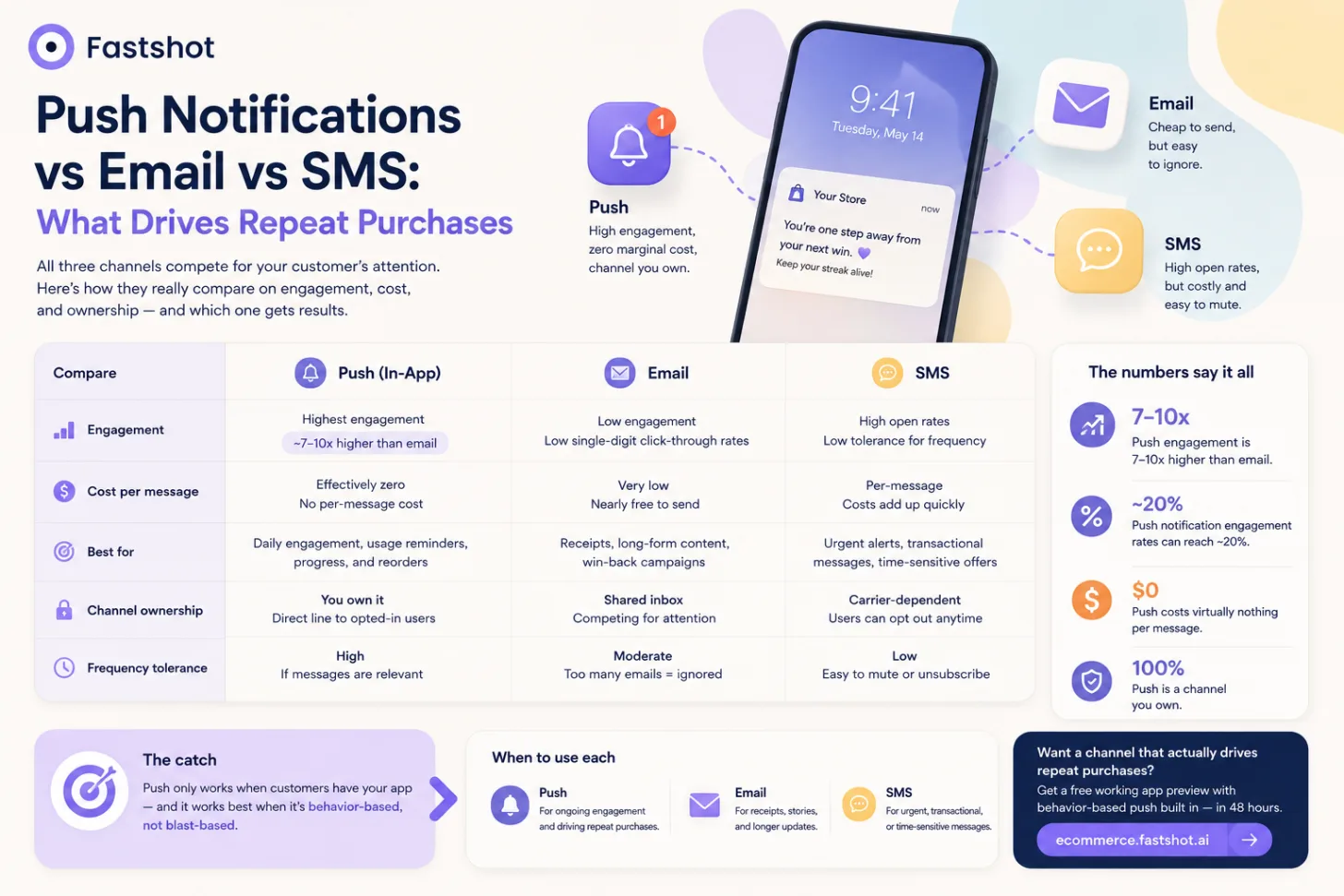
Every retention channel makes the same promise: send the right message at the right time and customers come back. But the three big channels — email, SMS, and push notifications — are not interchangeable. They differ enormously in how often people actually engage, what each message costs you, and whether you truly own the channel.
If your goal is repeat purchases, those differences decide where your effort pays off. Here's the honest comparison.
Email: cheap to send, easy to ignore
Email is the default retention channel because it's nearly free to send and everyone has it. The problem is engagement. Click-through rates sit in the low single digits, which means the large majority of customers never act on what you send. The inbox is crowded, promotional mail gets filtered, and "open" doesn't mean "bought."
Email still has a role — receipts, longer-form content, win-back sequences — but as a tool for driving frequent repeat behavior, it's working against the odds. You're broadcasting into a space designed to keep most of your messages from being seen.
Strengths: low cost, rich content, good for non-urgent communication. Weakness: low engagement; most messages are never acted on.
SMS: high open rates, high cost, easy to mute
SMS solves email's visibility problem — texts get opened. But it introduces two new ones. First, cost: you pay per message, so frequent sends get expensive fast, which forces you to ration exactly the kind of regular contact that builds a habit. Second, tolerance: customers mute or unsubscribe quickly when texts feel like marketing. SMS is built for transactional, occasional, high-value moments — not for the daily engagement that turns usage into a routine.
Strengths: high open rates, immediate, good for urgent or transactional moments. Weakness: cost per message and low tolerance for frequency limit how often you can use it.
Push notifications: high engagement, zero marginal cost, channel you own
Push notifications occupy a different tier. Engagement runs many times higher than email — on the order of 7–10× — with engagement rates that can reach around 20%. And unlike SMS, sending costs you nothing per message, so you're not penalized for staying in regular contact.
The deeper advantage is ownership. Push lives on a device the customer chose to install your app onto. You're not renting space in a crowded inbox or paying a carrier per text — you have a direct line to people who already opted in. That changes what's possible: you can reach customers by behavior (they're running low, they hit a streak, a routine step is due) rather than by generic blast.
Strengths: highest engagement, no per-message cost, behavior-based targeting, a channel you own. Requirement: the customer needs your app installed — which is exactly why a mobile app is the unlock.
Push vs email vs SMS: side-by-side
| SMS | Push (in-app) | ||
|---|---|---|---|
| Engagement | Low (low single-digit clicks) | High open, low tolerance | Highest (~7–10× email) |
| Cost per message | Very low | Per-message, adds up | Effectively zero |
| Best for | Receipts, long-form, win-back | Urgent, transactional | Daily/behavioral engagement |
| Channel ownership | Shared inbox | Carrier-dependent | You own it |
| Frequency tolerance | Moderate | Low | High, if relevant |
Why push notifications need a mobile app
Push's advantages all depend on one thing: the customer has your app. That's the real reason the channel comparison matters. You can't push your way to retention without an app, and you can't blast your way to retention even with one. The brands that win use push the way it's meant to be used — behavior, not blasts. A notification that fires because a customer is genuinely running low, or because they're one day from breaking a streak, gets acted on. A generic "we miss you!" push gets the notification permissions revoked.
This is why retention is ultimately a product problem, not a channel problem. The channel only works if there's behavior worth notifying about — usage, progress, depletion. Build the app around that loop, and push becomes the most effective retention channel you have. Bolt push onto a storefront with nothing behind it, and it's just another ignored interruption.
How to use push notifications for repeat purchases
If you're relying on email and SMS to fix retention, you're using your weakest and most expensive tools for the job. The highest-leverage move is to give customers an app worth installing — one built around a usage loop — so push notifications have something real to communicate.
Want to see what that looks like for your store? Drop your Shopify URL into Fastshot and get a free working app preview — with a behavior-based push system built in — in 48 hours.
Frequently asked questions
Are push notifications better than email for ecommerce? For driving frequent repeat engagement, yes — push engagement runs many times higher than email and costs nothing per message. Email is still useful for receipts and long-form content.
How often can I send push notifications? As often as you have something genuinely relevant to say. Behavior-triggered pushes (low stock, routine reminders, progress) are tolerated and acted on; generic marketing blasts get permissions turned off.
Do I need an app to send push notifications? For true native push that reaches customers reliably, yes — they need your app installed. That's the main reason a mobile app is the foundation of a strong push strategy.
See your app before you commit
Drop your Shopify store URL into Fastshot and get a free working app preview — built around your retention loop — in 48 hours. No card, no engineering.
Get my free preview →