
How to Get Customers to Download Your Shopify App
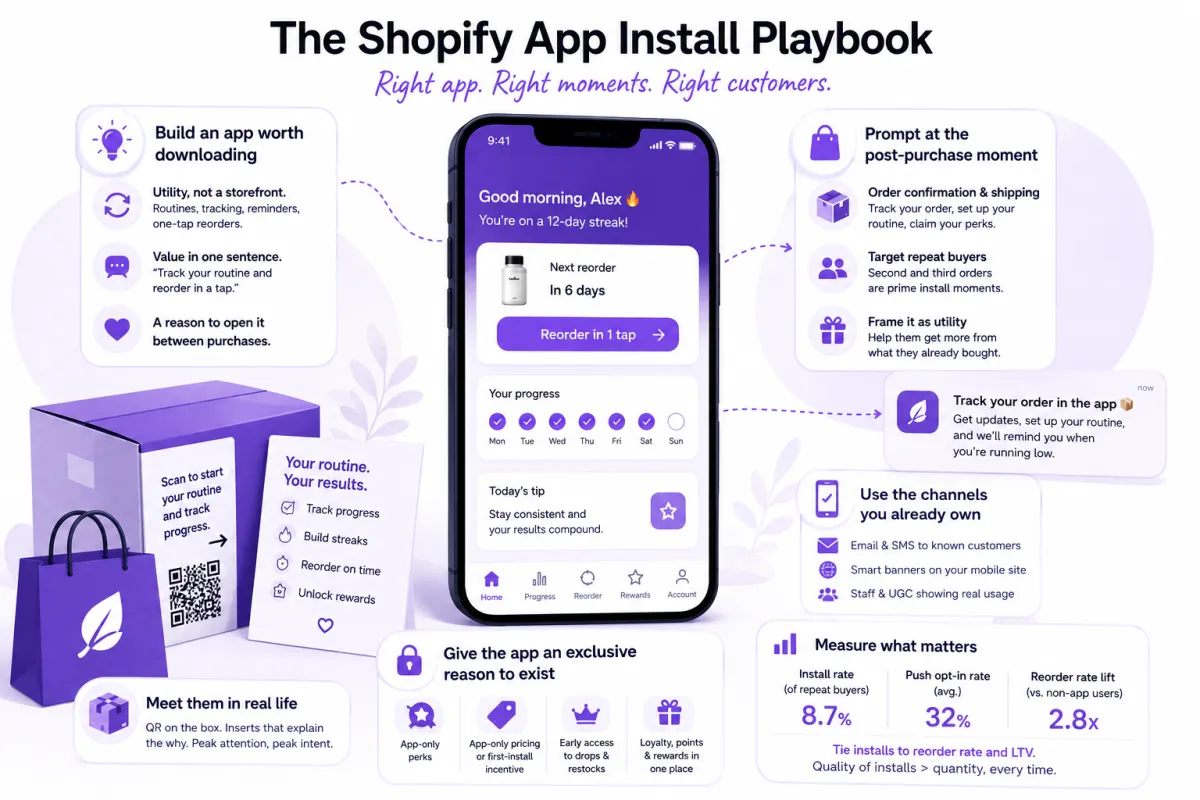
Here's the install playbook nobody wants to start with, but you have to: most of your customers will never download your app, and you shouldn't waste money trying to make them. DTC app adoption sits under a few percent of a brand's total customer base, and that's fine — because the whole point of a brand app is your repeat buyers, not your one-time traffic. The brands that fail at installs are the ones chasing the wrong number with the wrong pitch.
The reason is simple and worth saying plainly: nobody downloads a storefront. People don't want another way to shop with you on their phone — that's just your website with an extra step. They download utility — something worth opening between purchases. So before any tactic, the real prerequisite is that the app does something a website can't. Get that right and installs follow. Get it wrong and no banner or discount will save you.
Start with the only thing that earns an install
If your app is a catalog with your logo on it, your install rate will be miserable no matter how hard you push, because there's no reason to open it twice. The apps that get downloaded — and kept — give the customer a recurring reason to return: a routine to follow, progress to track, a reorder that's one tap when they're running low. (This is exactly why customers download some brand apps and ignore others.)
- Build utility, not a storefront. A protocol builder, usage tracking, streaks, reorder reminders timed to real depletion — these are reasons to open the app on a Tuesday with no intent to buy. (The difference between a storefront-in-an-app and a retention tool is the whole game.)
- Make the value legible in one sentence. "Track your routine and reorder in a tap" earns a download. "Shop our store, now in an app" does not.
Everything below assumes you've cleared this bar. Install tactics amplify a good app; they can't rescue a pointless one.
Prompt at the post-purchase moment
The single best time to ask for an install is right after someone buys, when intent and goodwill are highest and they actually have a reason to open the app — to track the order, set up their routine, or claim a perk.
- Order confirmation and shipping pages. Add a clear "track this in the app" prompt to the post-purchase flow and the shipping notification.
- Frame it as utility, not loyalty homework. "Set up your routine and we'll remind you when you're running low" beats "download our app."
- Catch repeat buyers specifically. A customer placing their second or third order is your highest-probability installer — prompt them, not the first-timer who may never come back.
Put the install on the product, literally
Your packaging is the one piece of marketing the customer is physically holding, fully engaged, with the product in hand. Retail saw an ~88% year-over-year jump in QR codes on packaging — because it works.
- QR code on the box and inserts. A scan-to-install code with a one-line reason ("Scan to start your routine and track progress") converts at the peak moment of brand attention.
- Make the landing relevant. Send the scan to a page about what the app does, not a generic app-store listing. Reduce the gap between "curious" and "installed."
- Use inserts for the why. A small card explaining the routine, the tracking, the one-tap reorder does more than a logo and a download badge.
Give the app an exclusive reason to exist
If the app offers nothing the website doesn't, there's no reason to switch. Manufacture one.
- App-only perks and early access. Drops, restocks, and limited products that go live in the app first give your best customers a real motive to install and keep it.
- App-only pricing or a first-install incentive. A modest, app-exclusive offer at install converts the fence-sitters — just make it a one-time hook, not a permanent discount that trains people to wait.
- House the loyalty program in the app. Points, tiers, and rewards living in one tappable place beats a loyalty email nobody opens.
Use the channels you already own to drive installs
You don't buy cold app-install ads — that's where adoption economics collapse and CPI eats your margin. You convert the audience you already have.
- Email and SMS to known customers. Your existing list is the cheapest install source you have. Segment to repeat buyers and pitch the utility.
- Smart app banners on your site. A native banner on your mobile site lets browsing customers tap straight to the app store — low-friction, high-intent.
- Staff and UGC. Your team and your fans showing the app in use (the tracking, the streaks, the reorder) is more persuasive than any badge. Real usage sells the install.
Measure install rate, not install count
A big download number from cold ads is a vanity metric if those users never reorder. Measure the thing that matters.
- Track installs against repeat customers, not your whole base. Realistic adoption is a single-digit percentage of all customers, but the right denominator is your repeat buyers — and converting 5–15% of them is a strong, healthy result.
- Watch opt-in and retention, not just installs. Around a third of users opt into push on average, and notified users return at multiples of those who aren't. An install that opts in and comes back is worth ten that don't.
- Tie installs to reorder rate and LTV. The only install worth celebrating is one that produces another purchase. Quality of installs beats quantity, every time.
The honest version of the playbook
Don't chase mass downloads. Build an app worth opening, prompt your best customers at the moments they're already engaged — post-purchase, on the box, in winback — give them an exclusive reason, and measure adoption against the cohort that actually drives your revenue. (If you're planning installs around a peak season, the BFCM angle matters too.) Two hundred repeat customers who now reorder in one tap beats a thousand casual installs that never open the app twice.
Curious whether your customers would actually install and use one? Drop your Shopify URL into Fastshot and see a free working app preview — built around utility your best customers will open, not a storefront they'll ignore — in 48 hours.
Frequently asked questions
What's a realistic install rate for a Shopify brand app? Across your entire customer base, single-digit percentages are normal — and that's fine. Measure against repeat customers instead, where converting roughly 5–15% is a strong result. The app is for your retention base, not your whole list.
When should I prompt customers to install the app? At engaged, high-intent moments: right after purchase, on the order-tracking and shipping screens, on your packaging via QR code, and in winback to known repeat buyers. Skip cold app-install ads — the cost per install rarely pays back for a DTC brand.
Why won't customers download my app? Almost always because it's a storefront, not a tool. People don't want another way to shop — they download utility they'll open between purchases: routines, tracking, progress, and one-tap reorders. Fix the app's reason to exist and the install tactics start working.
See your app before you commit
Drop your Shopify store URL into Fastshot and get a free working app preview — built around your retention loop — in 48 hours. No card, no engineering.
Get my free preview →