
Most Shopify Apps Are Just Storefronts. What a Retention App Actually Does
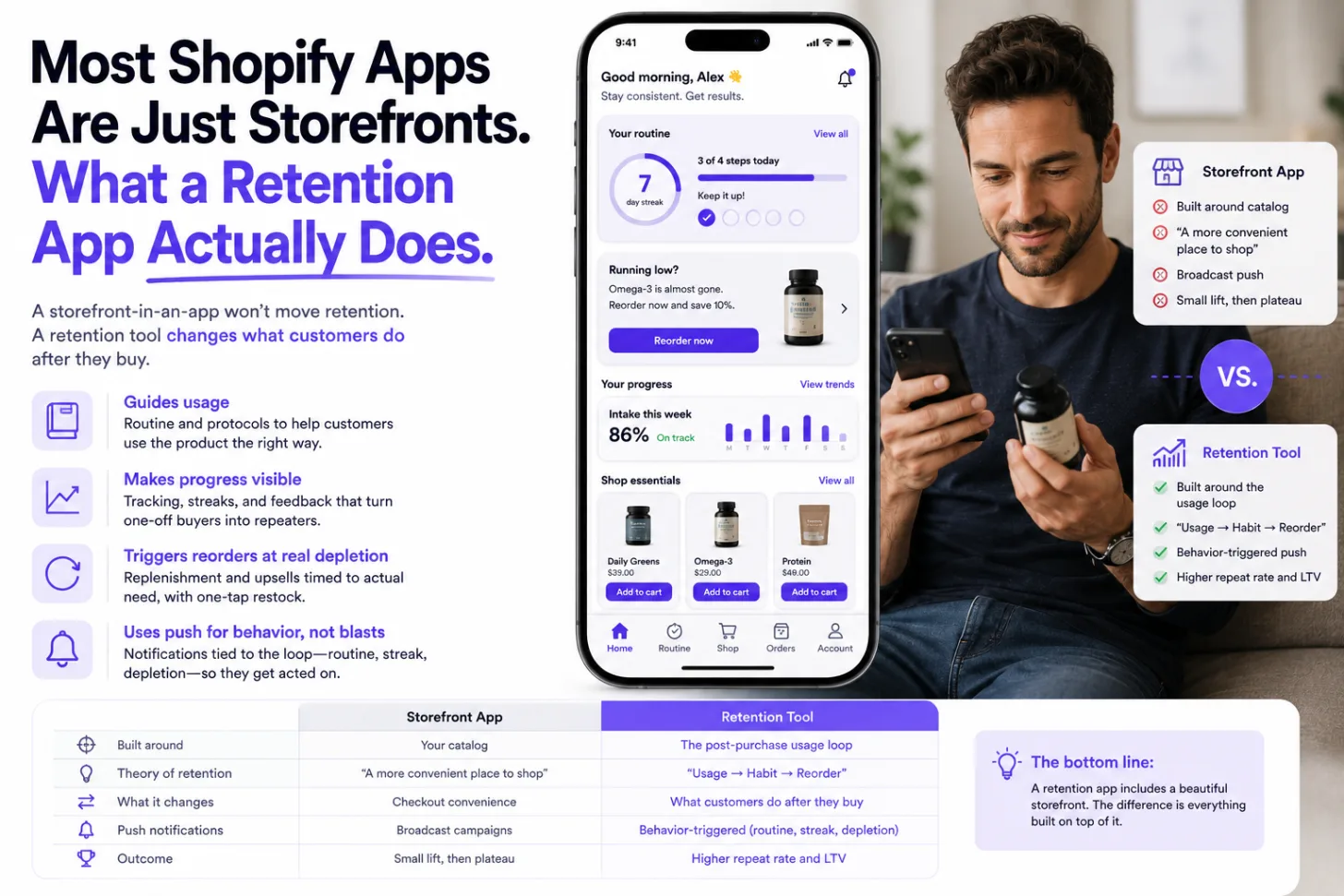
If you've evaluated mobile app builders and come away thinking "this is just my website in an app," your instinct was right. Most of them are exactly that. Drag your catalog in, match your branding, hit publish, and you've shipped a mobile storefront — not a retention tool.
That distinction sounds like a nuance. It's actually the whole decision. A storefront-in-an-app will underperform for the same reason your email and SMS plateaued: it doesn't change what customers do. So before you judge mobile apps as a retention channel, it's worth being precise about which kind of app you're looking at — because most of what's on the market won't move the metric you care about.
Why most app builders are glorified storefronts
The standard app builder is a template wrapper. It syncs your products, collections, customer accounts, and checkout into a native shell, lets you theme it, and publishes it to the app stores. The result is a catalog you can browse on a phone — faster and smoother than your mobile site, with push notifications bolted on.
That's genuinely useful, and for some brands it's enough. But be clear about what it is: a more convenient place to buy. The value starts and stops at "shopping, but nicer." Nothing in a storefront-app changes whether a customer uses the product, builds a routine, or has a reason to come back between orders.
The tell: if it only mirrors your store, it won't move retention
A storefront-app's entire theory of retention is "be a more convenient place to shop." Sit with that for a second against what you already know about why customers churn. Your repeat buyers didn't stop reordering because checkout was inconvenient. They stopped because they stopped using the product. (That's the core of the retention problem.)
A faster catalog does nothing for that. So a storefront-app gives you an app-store listing and a push channel, produces a small lift from the convenience, and then plateaus — exactly like the channels you've already maxed out. You don't need another version of the same ceiling. You need a tool that operates on behavior.
What a retention tool does that a storefront doesn't
A retention app is built around the post-purchase behavior loop, not the catalog. The storefront is still there — but it's the foundation, not the point. What sits on top is what a storefront-app can't do:
It guides usage
A routine or protocol mapped to your category, so customers actually use the product correctly and consistently — and get the result that makes reordering obvious. A supplement gets a daily intake routine; skincare gets an AM/PM regimen; coffee gets a brew-and-restock rhythm.
It makes progress visible
Tracking, streaks, and feedback that turn a one-off purchase into an ongoing habit. People repeat behaviors they can see working, and a storefront has nothing to show them.
It triggers reorders at real depletion
Replenishment and upsells timed to when a customer is actually running low based on how they use the product — not a generic 30-day campaign — paired with one-tap restock. The reorder meets them at the moment of real need.
It uses push for behavior, not blasts
Notifications tied to the loop — a routine step due, a streak about to break, a product running low — which is why they get acted on instead of muted. (Here's why behavior-based push outperforms email and broadcast.)
Storefront app vs retention tool, side by side
| Storefront app | Retention tool | |
|---|---|---|
| Built around | Your catalog | The post-purchase usage loop |
| Theory of retention | "A more convenient place to shop" | "Usage → habit → reorder" |
| What it changes | Checkout convenience | What customers do after they buy |
| Push notifications | Broadcast campaigns | Behavior-triggered (routine, streak, depletion) |
| Outcome | Small lift, then plateau | Higher repeat rate and LTV |
The storefront is table stakes — a retention tool includes one. The difference is everything built on top of it. (This is what a habit-forming app looks like in full.)
What to ask an app builder before you buy
Demos all look polished, so cut through them with questions that expose which kind of app you're actually evaluating:
- Does it change what customers do after they buy, or just display my products more nicely?
- Can it track product usage or progress — or only show order history?
- Can it trigger reorders based on real depletion, or only run scheduled campaigns?
- Is push tied to customer behavior, or is it just another broadcast channel?
- If I removed the storefront, is there anything left that drives a repeat purchase?
If the answers all amount to "it shows your products beautifully," you're being sold a storefront. That's fine if a faster mobile catalog is what you want — but don't expect it to fix a retention plateau, because plateaus aren't a convenience problem.
See the difference on your own store: drop your Shopify URL into Fastshot and get a free working preview of a retention app — full storefront, with the usage loop your category needs built on top — in 48 hours.
Frequently asked questions
Aren't all Shopify mobile apps basically the same? No. Most are storefront-apps — a native version of your catalog. A retention tool is built around the post-purchase usage loop (guided usage, progress, depletion-based reorders, behavior-based push). They look similar in a demo but do very different things to your repeat rate.
Will a storefront app improve my retention? Marginally, from the convenience of faster checkout and a push channel — then it plateaus. It doesn't change why customers churn, which is that they stop using the product, so it can't fix a retention plateau on its own.
What makes an app a "retention tool" rather than a storefront? It's built around behavior, not the catalog: it guides product usage, shows progress, triggers reorders at real depletion, and uses push tied to what customers actually do. The storefront is included as a foundation, not the whole product.
Do I still get a full storefront with a retention app? Yes. A retention app includes a complete native storefront with one-tap checkout — the usage and reorder loop is layered on top of it, not instead of it.
See your app before you commit
Drop your Shopify store URL into Fastshot and get a free working app preview — built around your retention loop — in 48 hours. No card, no engineering.
Get my free preview →