
Shopify Cart Abandonment: Strategies That Actually Recover Revenue (2026)
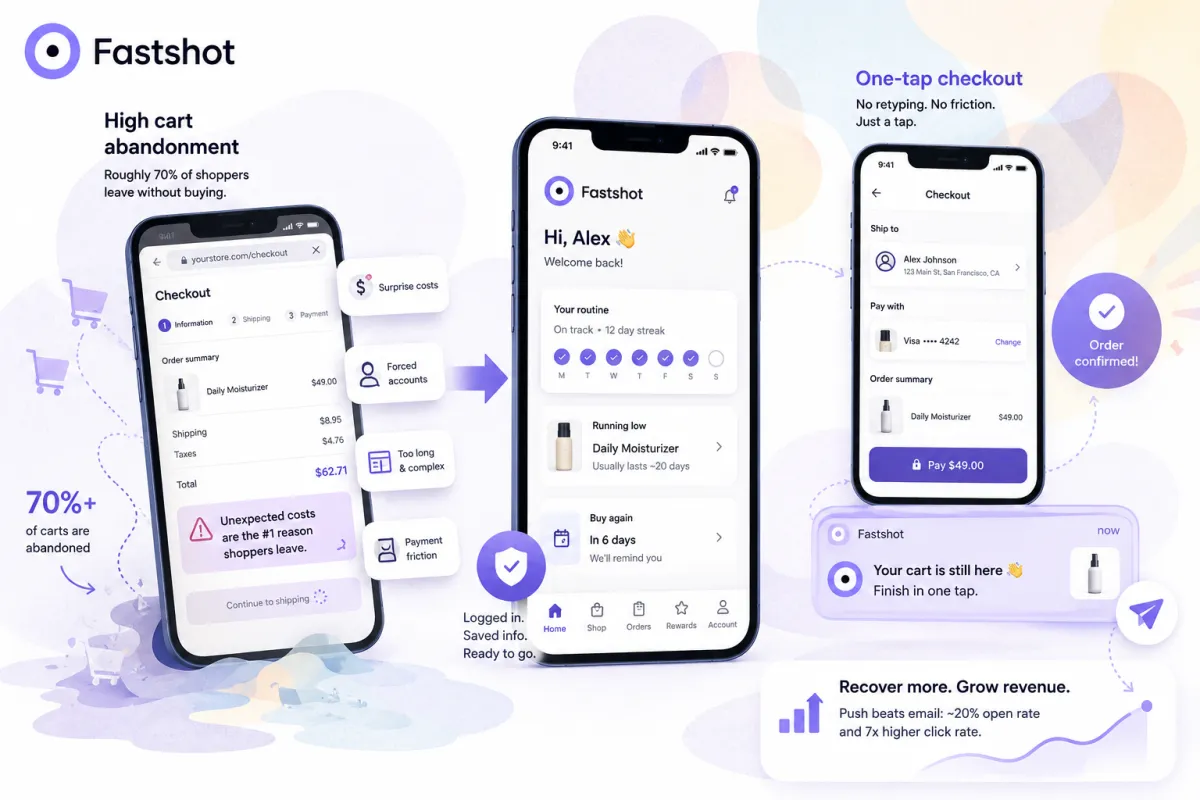
Roughly seven out of every ten people who add something to their cart on Shopify leave without buying. The 2026 benchmark sits right around 70% — and on mobile, where most of your traffic now lives, it climbs higher still, into the high-70s and sometimes past 80%. That's not a rounding error. That's the majority of your demand walking out the door after they've already told you they want to buy.
The good news is that abandonment is mostly not a mystery. People leave for a small set of repeatable reasons, and the standard recovery playbook — flows, checkout UX, trust, payment options — genuinely recovers revenue. The bad news is that the playbook has a ceiling, because it's mostly built to chase customers after they've left a friction-filled checkout. This post covers the tactics that work today, and then the structural fix that attacks the problem at the source: a logged-in mobile app where there's barely any cart to abandon in the first place.
Why carts actually get abandoned
Before you recover anything, fix what's causing the leak. Baymard's research is consistent year after year, and 2026 is no different — the top reasons people abandon at checkout are almost entirely self-inflicted design choices:
- Surprise costs — shipping, taxes, and fees that appear at checkout are the single biggest reason, cited by nearly half of abandoners. Nothing kills momentum like a total that jumps 20% on the final screen.
- Forced account creation — about a quarter of shoppers bail when made to register before buying.
- A checkout that's too long or complicated — roughly one in five leave because there are too many steps, fields, or pages.
- Trust and payment friction — concerns about payment security, plus not offering the payment method a shopper expects, quietly cost you conversions you never see.
Notice the pattern: most of these are preventable. They're not market forces — they're things in your control. That's where recovery starts.
The standard recovery playbook (and it works)
The conventional toolkit is conventional because it earns its keep. If you're not doing these, do them before anything fancier.
- Multi-step abandonment flows, not a single email. A one-email flow recovers in the low single digits. A proper sequence — email plus a well-timed SMS — pushes recovery toward the 8–12% range that top performers hit. The split most DTC brands land on is roughly 75–80% email, 20–25% SMS.
- Speed matters more than cleverness. A recovery message sent within an hour converts dramatically better than one sent a day later — the difference is on the order of 20% versus ~12% conversion. Fire the first touch fast.
- Kill the surprise costs. Show shipping on the product page, or fold it into pricing. Surfacing the real total early can lift checkout conversion by 15–25% on its own.
- Offer guest checkout and express payment. Let people buy without an account. Add Shop Pay, Apple Pay, Google Pay, and PayPal so they can skip form-filling entirely — Shop Pay alone can lift conversion meaningfully over guest checkout for returning shoppers.
- Compress the checkout. Fewer fields, fewer pages. One-page checkout reduces abandonment by around 20% on average. Every removed step is recovered revenue.
This is table stakes. Done well, the playbook turns a 70% problem into a slightly-less-than-70% problem and claws back a meaningful chunk of lost orders. But look closely at what it's actually doing: most of it is damage control on a checkout that's inherently high-friction on mobile, plus a chase sequence to win back people who already gave up.
The mobile problem the playbook can't fix
Here's the uncomfortable truth underneath the benchmarks. Mobile is where your traffic is, and mobile web is where abandonment is worst — high-70s, sometimes mid-80s. Mobile web converts at roughly 1.8%, while desktop more than doubles that. The mobile browser is a hostile checkout environment: tiny forms, re-typed addresses, payment sheets that don't autofill, a re-login every visit, and a dozen tabs competing for attention.
You can optimize a mobile-web checkout all day and it will still bleed, because the medium itself adds friction at exactly the moment you need none. Recovery flows are a tax you pay because the checkout leaked in the first place. (This is the core of the app-versus-mobile-web tradeoff.)
The structural fix: reduce abandonment at the source
A logged-in native app changes the physics of the problem. The customer is already authenticated, payment and shipping are already saved, and there's no form to fill — checkout is a tap, not a gauntlet. That's why apps routinely convert at multiple times the mobile-web rate. You're not recovering an abandoned cart; you're preventing it from ever forming.
- No re-auth, no re-entry. Saved payment and a persistent login remove the two biggest mobile checkout chores at once.
- A cart that survives. In an app the customer keeps coming back to, an unfinished cart isn't a lost session — it's still right there next time they open it.
- Fewer surprise-cost ambushes. A returning, logged-in buyer who already knows your shipping isn't getting blindsided on the final screen.
The result is that the behavior you were trying to recover with email and SMS happens natively, with far less leakage to recover in the first place.
Recovering the carts that still slip — with push
No checkout is perfect; some carts will still go cold. The difference is how you reach the customer who left. Email open rates hover in the 30s–40s and clicks sit in low single digits. Push notifications to an app the customer installed run dramatically higher engagement — open rates around 20% and click rates that can be 7x email — and they cost nothing per send.
That means your abandonment "recovery" stops being a paid SMS gamble and becomes a free, high-visibility nudge: "Your cart's still here — finish in one tap." And because it's a channel you own, you can trigger it on real behavior rather than blasting a list. (Here's how push stacks up against email and SMS for recovery.) The brands that get this right treat push as a precise, behavior-based tool — not another interruption to ignore. (A deliberate push strategy is what separates recovery from spam.)
Put it together
Fix the leaks first: surface costs early, allow guest checkout, add express payment, compress the steps, and run a fast multi-step recovery flow. That's the floor, and it pays. Then attack the structural cause — a mobile-web checkout that's inherently high-friction — by giving your repeat buyers a logged-in app where checkout is one tap and recovery is a free push instead of a paid chase.
Want to see what that looks like for your store? Drop your Shopify URL into Fastshot and see a free working app preview — with saved-payment checkout and behavior-based push built in — in 48 hours.
Frequently asked questions
What's a normal cart abandonment rate for a Shopify store in 2026? Around 70% across all devices, with mobile web running higher — often high-70s to low-80s — and desktop lower. If you're meaningfully above 75% overall, look first at surprise costs, forced account creation, and checkout length.
What's the single highest-leverage fix for abandonment? Removing surprise costs and friction at checkout beats any recovery flow, because it prevents the abandonment instead of chasing it. Show shipping early, allow guest checkout, add express payment, and cut the number of steps before you invest more in win-back messaging.
How does a mobile app reduce cart abandonment? A logged-in app stores payment and shipping and keeps the customer authenticated, so checkout is a single tap instead of a multi-field form. That removes the friction that drives mobile-web abandonment, and the carts that still go cold can be recovered with free, high-visibility push notifications instead of paid SMS.
See your app before you commit
Drop your Shopify store URL into Fastshot and get a free working app preview — built around your retention loop — in 48 hours. No card, no engineering.
Get my free preview →