
Does Your Shopify Store Actually Need a Mobile App Yet?
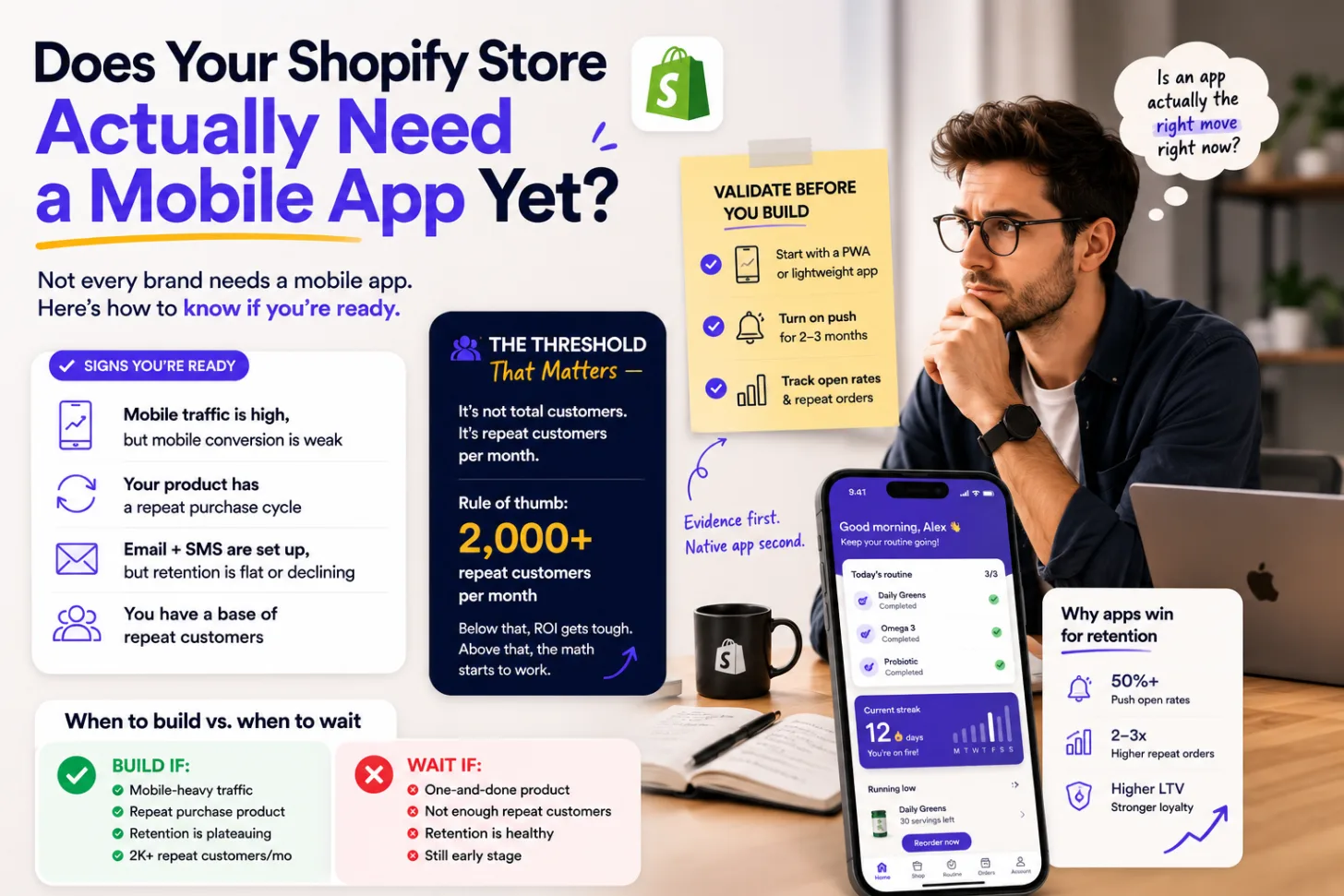
Most "you need an app" advice comes from people who sell apps, so let's start somewhere more honest: plenty of Shopify brands don't need one, and building too early is a reliable way to burn money. An app earns its place under specific conditions — and there's a clean way to test whether you've hit them before you commit to a native build.
Here's the readiness check, including the threshold that actually matters and how to validate demand cheaply first.
The honest answer: not every store needs an app
An app is a retention tool, not a growth requirement. If your retention is already healthy, or your product is genuinely bought once and never again, you probably don't need one yet — and no amount of app marketing changes that.
So the real question isn't "should every brand have an app." It plainly shouldn't. The question is whether you are in the specific situation where one pays for itself. A few signals tell you.
The signals that say you're ready
You're likely ready if several of these are true at once:
- Your traffic is mobile-heavy, but your mobile-web conversion is weak. A large mobile audience meeting a mediocre mobile experience is money left on the table — and the single most common reason brands at your stage look at apps.
- Your product has a real reorder cycle — consumables, replenishables, or anything tied to a routine or protocol.
- Retention is plateauing or declining despite a built-out email and SMS stack. (If that's you, here's why the standard stack hits a ceiling.)
- You already have a base of repeat customers driving meaningful revenue — not just a big top-of-funnel.
One or two of these and it's worth watching. Most or all of them, and an app is probably the highest-leverage retention move you haven't made. (Here's the fuller app-vs-mobile-web tradeoff.)
The threshold that matters: repeat customers, not total customers
The number to look at isn't total orders or email-list size — it's repeat customers per month. That's the cohort an app actually serves. (This is the same top-20% logic behind who downloads.)
As a directional rule of thumb from operators who've actually done this: below roughly a couple thousand repeat customers a month, a native app gets hard to justify on ROI alone — the build and upkeep can outweigh the retained revenue. Above that, the math starts to tip in its favor. Treat it as a sanity check rather than a hard line: your margin, average order value, and reorder frequency all move the threshold. A high-AOV brand with frequent reorders clears the bar at lower volume than a low-margin one.
How to validate demand before going native
The good news is you don't have to gamble on a full native build to find out. The low-risk path operators use looks like this:
- Start with a PWA or a lightweight wrapper. Cheap, fast, and enough to put a real app-like experience and push in customers' hands.
- Turn on push and run it for two to three months.
- Watch two numbers: push open rate and repeat orders through the app.
If push open rates hold well above email levels and you're seeing genuine repeat orders come through the app channel, the demand is real — that's your signal to invest in native. If engagement is flat, you've learned that for a fraction of the cost of building the wrong thing. (And behavior-based push is what makes those open rates hold up.)
Either way, you're buying evidence before you buy a native app — which is exactly how a skeptical operator should approach this.
When to wait
Hold off if:
- Your product is genuinely one-and-done, with no natural reorder.
- You don't yet have a repeat-customer base for the app to serve.
- Your mobile-web retention is honestly fine.
An app amplifies an existing retention motion — it doesn't manufacture one from nothing. If there's no reorder behavior to build on, fix that first; an app won't paper over it.
What "ready" looks like for a $50K–$100K/month brand
If you're doing $50K–$100K+ a month, your traffic skews mobile, your product gets reordered, and your repeat rate has flattened despite a working email and SMS stack — you're the textbook case. You have the volume for the math to work and precisely the problem an app is built to address. The validate-first path just lets you confirm it without overcommitting.
The lowest-risk way to start is to see the thing before you build anything. Drop your Shopify URL into Fastshot and get a free working app preview — built around your repeat customers and their reorder loop — in 48 hours.
Frequently asked questions
Does every Shopify store need a mobile app? No. An app is a retention tool for brands with repeat-purchase products and an existing base of repeat customers. If your product is one-and-done or your retention is already strong, you likely don't need one yet.
How many customers do I need before building an app? Look at repeat customers per month, not total customers. As a directional benchmark, roughly a couple thousand repeat customers a month is where a native app starts to pay off — adjusted up or down by your margin, AOV, and reorder frequency.
Should I build native or start with a PWA? Validate first. Run a PWA or lightweight wrapper with push for two to three months; if push open rates hold above email levels and repeat orders come through the app, then invest in native.
How do I know an app will work for my brand before building it? Test demand cheaply: put a lightweight app-like experience and push in front of your repeat customers, then watch push open rates and app-channel repeat orders. Strong signals there are your green light for native.
See your app before you commit
Drop your Shopify store URL into Fastshot and get a free working app preview — built around your retention loop — in 48 hours. No card, no engineering.
Get my free preview →